Eliminate Complexity

See how direct transfer eliminates unnecessary infrastructure.

Start Free

Enterprise File Transfer Has Become Increasingly Complex

Moving a file inside an enterprise is no longer just about transferring data—it requires managing the infrastructure around it. A single transfer may involve servers, shared storage, temporary repositories, permissions, monitoring, and recovery procedures.

As enterprise environments expand, these systems and operational tasks multiply. Organizations can end up spending more resources managing transfer infrastructure than moving files.
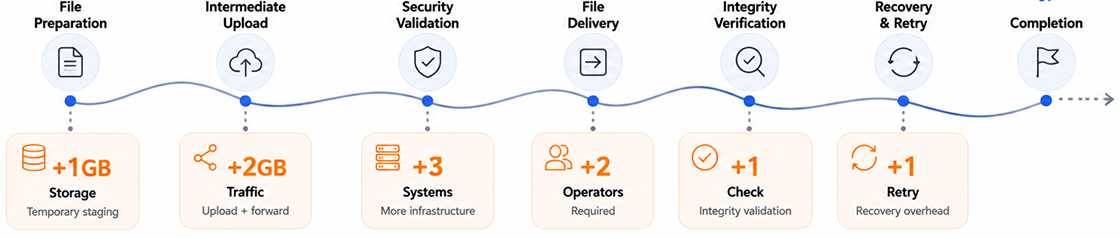
Transferring a 1GB File Can Generate More Than 3GB of Data Movement

Traditional architectures repeatedly copy, store, and forward files through intermediate systems before they reach their destination. As a result, transferring a 1GB file can generate more than 3GB of network traffic, along with duplicate storage, security overhead, and operational costs.

At 1TB scale, the problem grows dramatically. The real cost is not the file itself, but the infrastructure required to move it.

File transfer complexity chain

New Complexity Created by Distributed Infrastructure

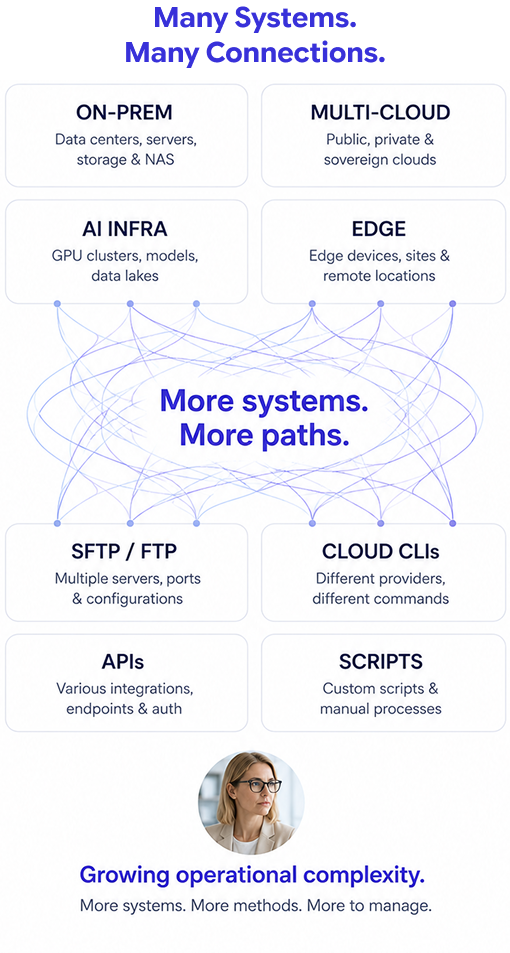
Today, enterprise data moves continuously across on-premises, hybrid cloud, multi-cloud, AI infrastructure, edge systems, and global data centers.

As the number of systems grows, file transfers between them increase exponentially, creating more transfer paths and operational environments to manage.

Different Systems. Different Transfer Methods.

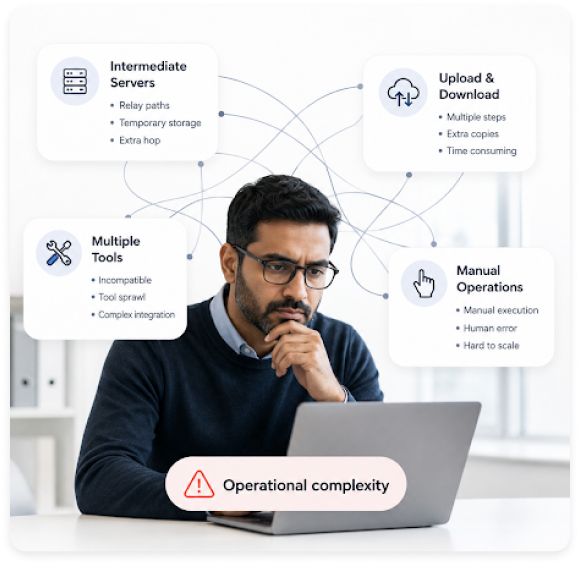
Each system requires its own transfer protocols, connection methods, and operational architecture. Organizations must operate SFTP, cloud CLIs, shared storage, relay servers, replication tools, scripts, and APIs simultaneously. Every new system adds transfer routes, accounts, permissions, and operational procedures.

As a result, enterprises are managing a growing collection of disconnected transfer technologies and increasingly complex transfer infrastructure.

How complexity became the enterprise standard

How Did This Complexity Become the Enterprise Standard?

Enterprise file transfer is often slow and complex—not because it needs to be. Over time, essential business policies became intertwined with unnecessary procedures created by legacy technologies. Eventually, the two became indistinguishable. Delays, operational overhead, and redundant infrastructure became accepted as simply part of enterprise file transfer.

INNORIX separates what the business requires from what technology created—eliminating the complexity enterprises don't need.

How complexity became the enterprise standard

Keep the necessary.

Eliminate the unnecessary.

Business and compliance processes that must be preserved

Business & Compliance Processes That Must Be Preserved

Security policies, regulatory compliance, approvals, and audits are essential business requirements. INNORIX preserves these controls while removing unnecessary technical procedures from file movement.

Technology-Induced Complexity Complexity That Should Be Eliminated

Legacy transfer technologies create complexity the business never required. Intermediate servers, duplicate copies, incompatible tools, and manual operations are technology limitations—not business requirements. INNORIX eliminates this complexity.

Technology-induced complexity that should be eliminated

Complexity Became the Standard.

It's time to redesign file movement.

Three Principles for Eliminating Technology-Induced Complexity

INNORIX eliminates unnecessary complexity created by legacy transfer technologies. Direct Transfer, Enterprise File Orchestration, and Extreme Resilience work together to make enterprise file movement simpler, more reliable, and automated.

Direct Transfer Connect Source and Destination Directly

Direct Transfer Connect Source and Destination Directly

Traditional file transfer architectures are designed to move files through multiple intermediate systems.

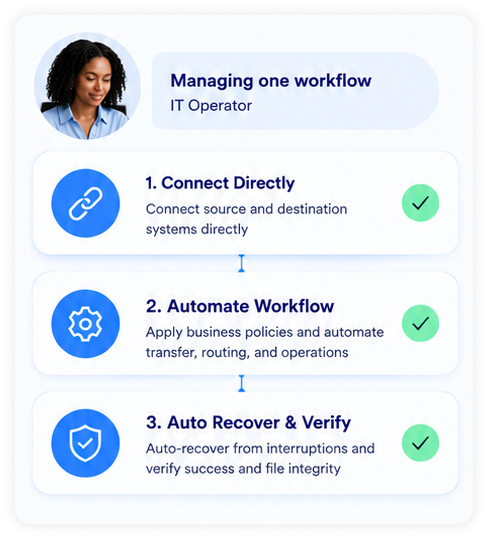
INNORIX connects the source and destination systems directly, allowing files to travel through the shortest possible path.

By eliminating intermediate servers, temporary storage, and repeated uploads and downloads, organizations also reduce duplicate copies, user accounts, access permissions, and operational overhead.

Enterprise File Orchestration Manage Everything from One Platform

Enterprise File Orchestration Manage Everything from One Platform

Today, systems create data, and systems consume it.

Files generated by AI, applications, servers, cloud platforms, storage systems, and edge devices are automatically delivered to the next system, creating one continuous enterprise workflow.

Instead of waiting for manual intervention, files move automatically through every stage—creation → processing → analysis → deployment → archival—while administrators manage the entire workflow rather than individual file transfers.

Extreme Resilience Transfers Continue Even When Failures Occur

Extreme Resilience Transfers Continue Even When Failures Occur

Enterprise file transfers do not always take place over stable networks. Long-distance connections, international networks, mobile environments, factories, and remote sites are all subject to unexpected failures and interruptions.

INNORIX continuously preserves transfer state and automatically resumes from the last completed point whenever a failure occurs.

Administrators no longer need to investigate failures or restart transfers from the beginning.

Compare the Entire File Transfer Architecture

Traditional file transfer technologies have evolved by adding individual features over time.

However, in real-world enterprise environments, it is the overall transfer architecture—not individual features—that determines infrastructure requirements, storage usage, security, operational complexity, and total cost.

INNORIX doesn't simply add another feature. It redesigns the entire file transfer architecture.

Compare the entire file transfer architecture

The Power of Zero

One Platform.
Zero Unnecessary Infrastructure.

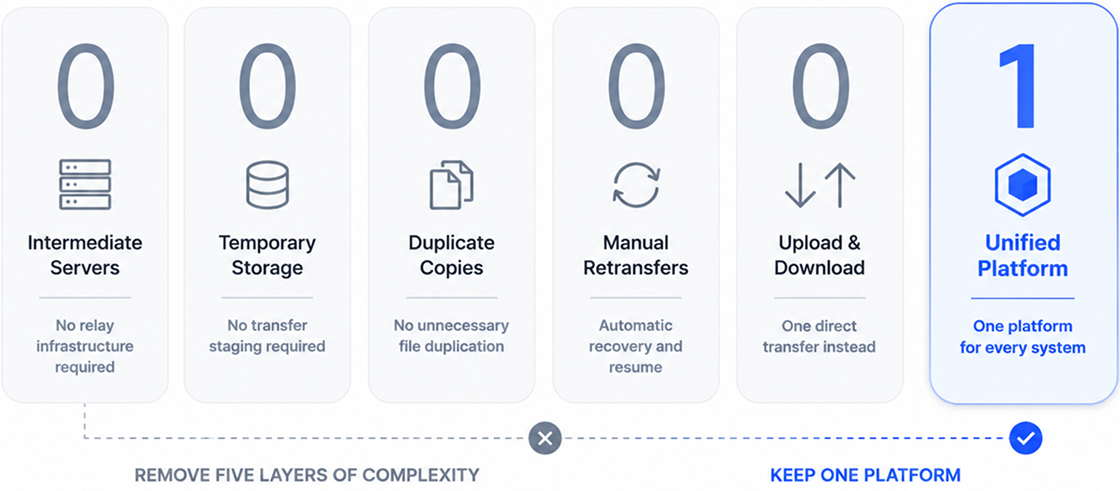
INNORIX removes all unnecessary components, making enterprise file movement simpler, faster, and more efficient to operate.

Direct Transfer, Enterprise File Orchestration, and Extreme Resilience remove infrastructure built solely for file movement, reducing operational complexity across the entire enterprise.

The Power of Zero — one platform, zero unnecessary infrastructure

Ready to ReplaceComplex File Transfer?

Start your first simplified enterprise file transfer.