Getting Started
Basic Concepts
Automatically connect file collection through processing and result delivery
In media and data workflows, the location where files are created, the equipment that processes them, and the location where the results are used may all be different.
For example, you can collect video files generated by multiple recording devices, transfer them to a conversion server, store the processed results in storage, and then transfer them to the next work environment.
File Creation
    │
    ▼
File Collection
    │
    ▼
File Processing
    │
    ▼
Result Use
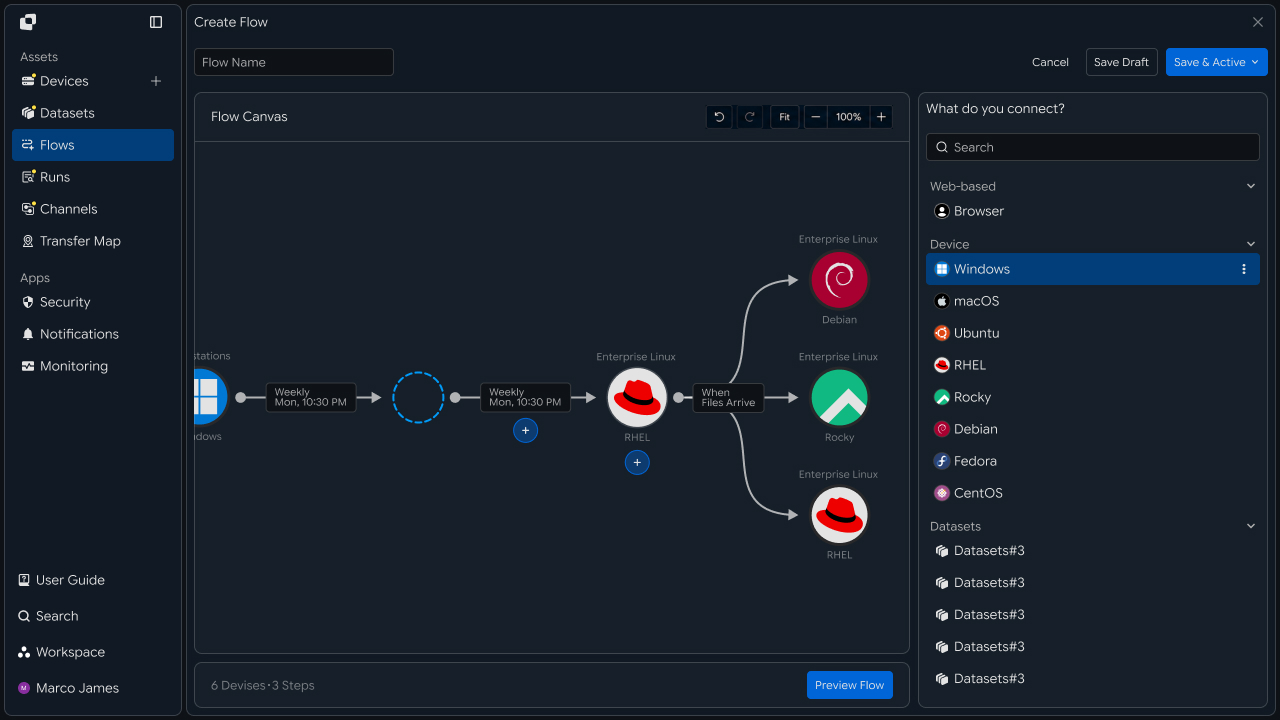
The result of each stage becomes the input for the next task, allowing you to connect everything from file creation through collection, processing, and result use in a single flow.
Automated Flow
Collect files from multiple devices and process them in a defined order
In an automated flow, files generated by multiple devices are collected as one task and the collected results are connected to the required processing equipment.
When processing is complete, you can transfer the resulting files to a designated location for use in the next task.
Source A ───┐
            │
Source B ───┼──→ Collect
            │       │
Source C ───┘       ▼
                  Process
                     │
                     ▼
                  Result
By configuring each next stage to run based on file status and task completion conditions, you can automatically connect file tasks in sequence.
Automation Benefits
Reduce repetitive file movement and management at each stage
When multi-stage file tasks are handled separately, file preparation, transfer, and processing-result checks are repeated.
By configuring an automated flow, you can connect the result of each previous stage to the next task and manage the process after file creation as one flow.
| Category | Individual File Processing | Automated Flow |
|---|---|---|
| File Collection | Check files from each device separately | Collect files from multiple devices in one flow |
| Processing Execution | Run the task after preparing files | Run the next task based on the collection result |
| Result Use | Manage completed files at the next location | Connect results to designated locations and tasks |
| Progress Check | Check each stage separately | Check the overall flow and results by stage |
This allows file tasks distributed across multiple devices and systems to be connected in a single automated flow.
IT Engineers
Configure an automated processing flow for media and data files
Collection Environment
Connect file-generating devices to collection locations
First, connect the devices where files are generated to the locations where the files will be collected.
Configure environments where files are generated, such as recording devices, business servers, data collection equipment, and storage, as Sources, and specify the file path to use on each device.
Source Devices
      │
 ┌────┼────┐
 ▼    ▼    ▼
Cam  Server Storage
 │      │      │
 └──────┼──────┘
        ▼
    Collection
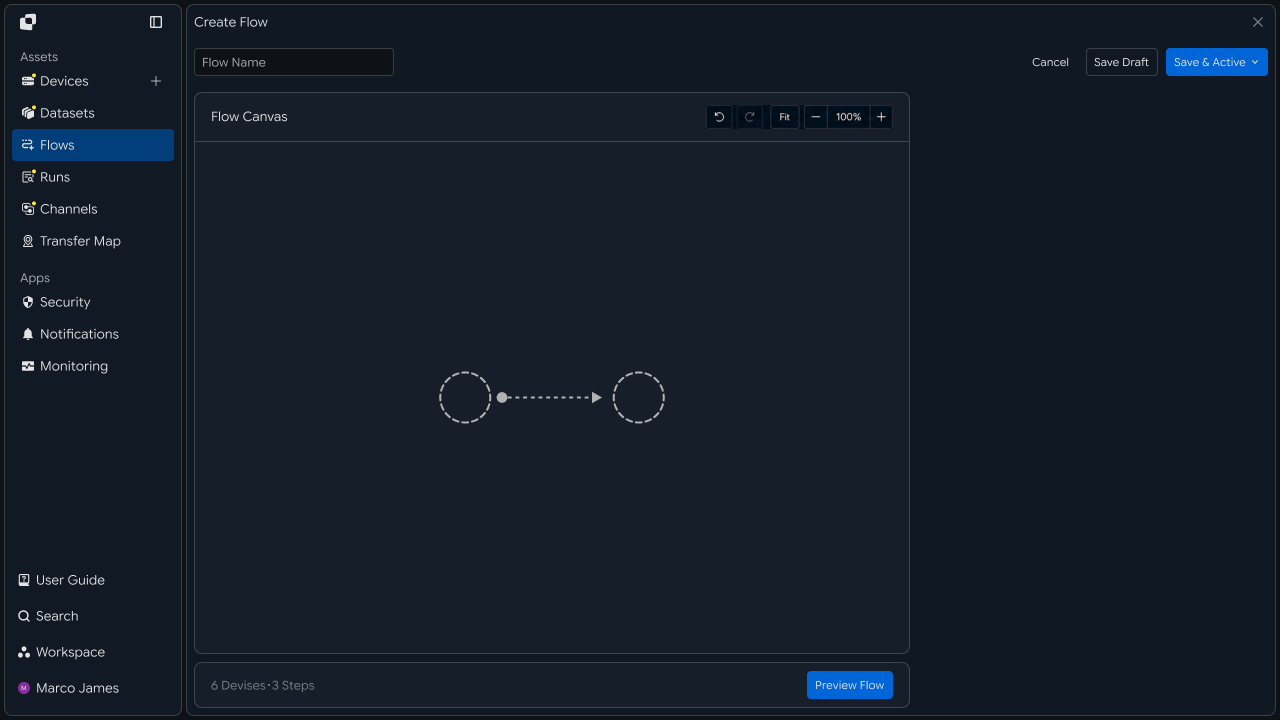
Configuring the collection environment lets you connect files generated in multiple locations into one automated flow.
Processing Connection
Connect collected files to the required processing equipment
Connect collected files to environments that perform the required tasks, such as conversion servers, analysis servers, and AI processing equipment.
You can consolidate files from multiple Sources into one processing device or connect them to different tasks based on file type and processing conditions.
Source A ───┐
            ├──→ Collect ───→ Process Server
Source B ───┤                       │
            │                       ▼
Source C ───┘                   Processing
When processing is complete, connect the resulting files to the next result stage.
Result Delivery
Store processing results and connect them to the next work environment
Transfer processed result files to locations used by the next task, such as storage, servers, and applications.
By connecting result storage and transfer to the next work environment as one result stage, you can automatically continue from processing completion to file use.
Processing
     │
     ▼
Result Files
     │
 ┌───┴───────┐
 ▼           ▼
Storage   Next System
If needed, you can extend the file-use flow by connecting notifications or additional processing tasks after result delivery.
Execution Conditions
Run the next stage based on file and task status
Each stage can be configured to run according to specified conditions.
For example, you can configure the flow to start collection when a file is created, run processing when collection is complete, and start result delivery when the processing result is ready.
File Ready
    │
    ▼
Collect Complete?
    │
   Yes
    │
    ▼
Start Processing
    │
    ▼
Result Ready?
    │
   Yes
    │
    ▼
Deliver Result
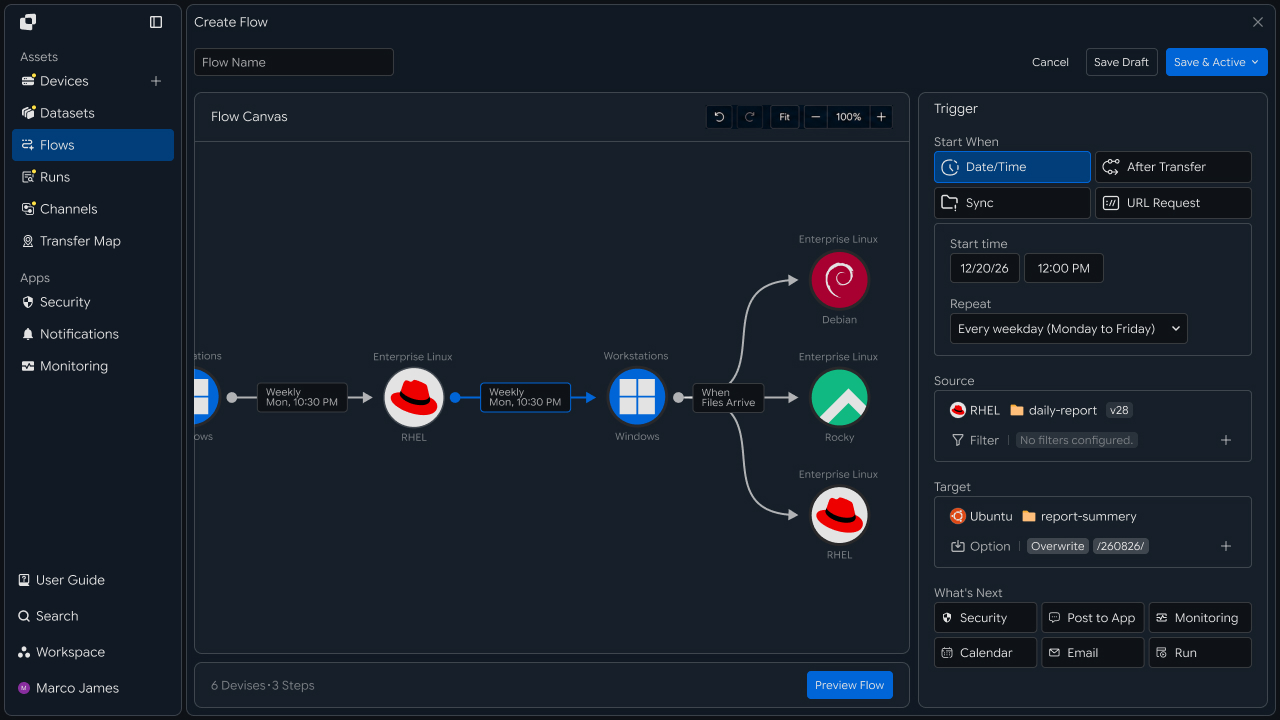
By using file status and the result of the previous task as execution conditions, you can connect multiple tasks in a defined sequence.
Result Verification
Check the overall flow and processing status by stage
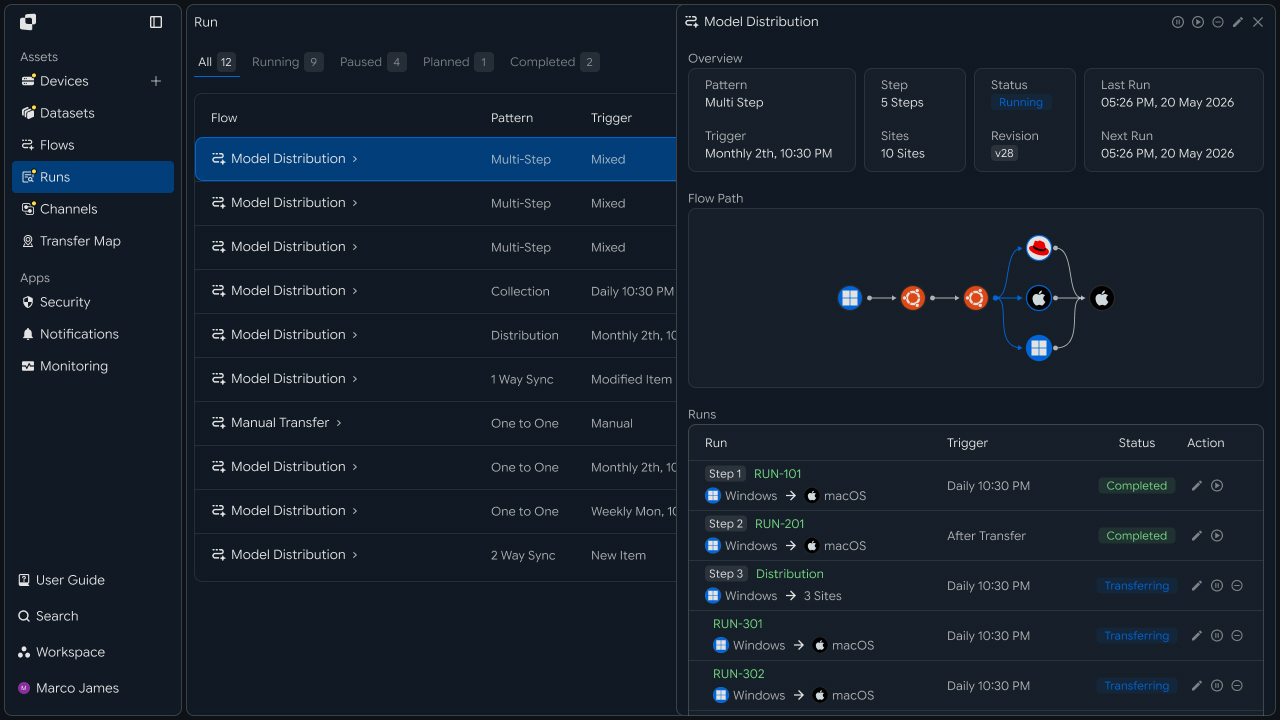
When the automated flow runs, you can check the overall workflow status and the processing result of each stage together.
You can check how far the current task has progressed based on collected files, processing tasks, and result delivery status.
Workflow Run
     │
 ┌───┼──────────────┐
 ▼   ▼       ▼      ▼
Collect Process Result Complete
  ✓      ✓       ●
                 │
              Running
| Check Stage | Main Check |
|---|---|
| Collection | Collected files and execution status |
| Processing | Processing task and progress result |
| Result | Stored or transferred result files |
| Overall Execution | Workflow progress status and execution time |
Checking the overall flow and individual stage statuses together lets you quickly understand the current progress and processing results.
Exception Handling
Review stages that need attention and rerun the task
If additional review is required during execution, check the details and execution history for the relevant stage.
You can select the task requiring attention among file collection, processing equipment, and result delivery, check device connections, file paths, and processing status, and then rerun the required task.
Workflow Run
     │
     ▼
Status Check
     │
 ┌───┴────────┐
 ▼            ▼
Completed   Attention
                │
                ▼
          View Details
                │
                ▼
          Check Settings
                │
                ▼
              Retry
                │
                ▼
          Result Confirmed
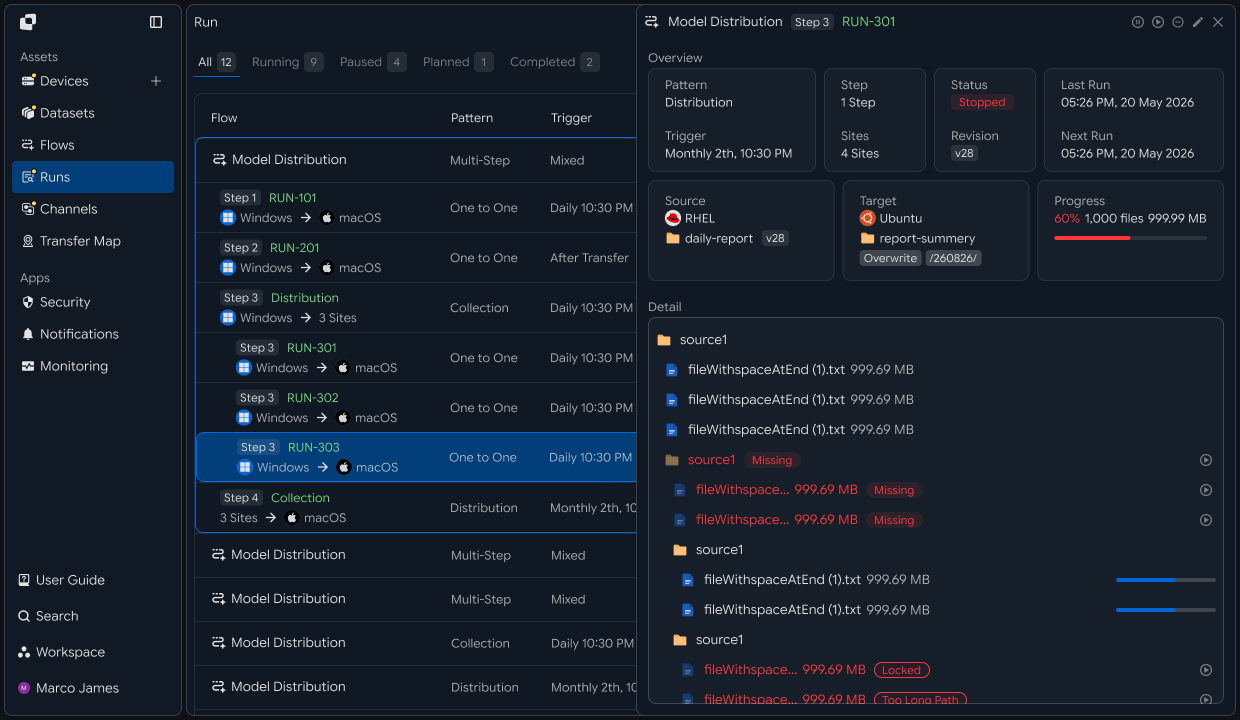
| Check Item | Check Details | Follow-up Task |
|---|---|---|
| Collection Environment | Device connection and file path | Check the environment and rerun |
| Processing Task | Processing status and execution result | Check the processing environment |
| Result Delivery | Target location and transfer status | Check the connection status and rerun |
| Execution History | Task information by stage | Review the details and take action |
Developers
Select targets by extension and size, collect them on processing equipment, and pass results to the next device
Integration Setup
Prepare common API-call code and path notation
import os
import requests

BASE_URL = os.getenv("INNORIX_BASE_URL", "https://app.innorix.com").rstrip("/")
TOKEN = os.environ["INNORIX_ACCESS_TOKEN"]
WORKSPACE_ID = os.getenv("INNORIX_WORKSPACE_ID")   # optional; falls back to the current workspace

STATUS_COMPLETE = 2
TERMINAL = {2, 4, 5, 9, 99}          # complete / error / cancelled / partial / failed
NOT_SUCCEEDED = {4, 5, 9, 99}


def api(method, path, body=None, params=None):
    headers = {
        "Content-Type": "application/json",
        "Authorization": f"Bearer {TOKEN}",
    }

    if WORKSPACE_ID:
        headers["x-workspace-id"] = WORKSPACE_ID

    response = requests.request(
        method, BASE_URL + path,
        headers=headers, json=body, params=params, timeout=30,
    )

    payload = response.json() if response.content else {}

    if not response.ok:
        raise RuntimeError(payload.get("message") or f"HTTP {response.status_code}")

    return payload.get("data")


def is_terminal(detail):
return detail.get("isTerminal", detail.get("status") in TERMINAL)import base64
import time
def encode_path(device_id, raw_path):
normalized = str(raw_path or "").replace("\\", "/")
token = base64.b64encode(normalized.encode("utf-8")).decode("ascii")
return f"{device_id}_ino_{token}"
def now_iso():
return time.strftime("%Y-%m-%dT%H:%M:%S.000Z", time.gmtime())Transfer status is determined by the values below. There are five terminal states, and the value corresponding to success is Complete (2).
| Status Value | Meaning | Terminal |
|---|---|---|
| 2 | Complete | Yes |
| 4 | Error | Yes |
| 5 | Canceled | Yes |
| 9 | Partially Complete | Yes |
| 99 | Failed | Yes |
| 1 · 6 · 12 · 13 | Starting · Transferring · Synchronizing · Receiving | No |
Target Filtering
Filter files to send by extension, size, and name conditions
Specify filters in the transfer options so that only files matching the conditions are sent instead of the entire source folder.
def build_filter(exts=None, min_size=None, exclude=None):
    file_option = {}

    if exts:
        # extension whitelist, without the leading dot
        file_option["extension"] = {
            "extension": [e.lstrip(".").lower() for e in exts],
            "allow": True,
        }

    if min_size is not None:
        # over and equal both True means size or larger
        file_option["fileSize"] = {"size": min_size, "over": True, "equal": True}

    if exclude:
        # allow=False excludes files whose name contains this. Server matching is case sensitive.
        file_option["fileName"] = {"name": exclude, "allow": False}

    return {"send-fileoption": file_option} if file_option else {}
The extension filter uses send-fileoption.extension. The send-filetype-cus regular expression matches only filenames without their extensions, so it does not work as an extension condition.
| Filter | Location | Behavior |
|---|---|---|
| Extension | send-fileoption.extension | allow: true means only this extension is transferred |
| Size | send-fileoption.fileSize | over·equal specifies the threshold |
| Name | send-fileoption.fileName | allow: false means matching files are excluded |
When multiple filters are provided, they are combined with AND. Only files that pass all filters are transferred.
FILTER = build_filter(exts=["mp4", "mov", "wav"], min_size=1024, exclude=".tmp")Verify through a search that the conditions work as intended before adding them to the automation.
page = api("POST", f"/api/devices/{SOURCE_ID}/files/search",
           {"path": SOURCE_PATH, "pageSize": 500})

matched = [i for i in page["items"]
           if i["type"] == "file" and i["name"].lower().endswith((".mp4", ".mov"))]

print(f"{len(matched)} matched")
The search does not accept condition parameters, so evaluate the returned results.
File Collection
Collect files from multiple devices on one processing device
One transfer handles one source device. Create a transfer for each device and separate the destination path for each source.
SOURCES = [
    ("device-cam-01", "/media/raw"),
    ("device-cam-02", "/media/raw"),
    ("device-mic-01", "/audio/raw"),
]

for source, source_path in SOURCES:
    # give each source its own folder so file names do not collide
    target_path = f"/work/incoming/{source}"

    monitor_id = api("POST", "/api/transfers/manual", {
        "sourceDevice": source,
        "targetDevice": PROCESS_ID,
        "targetPath": target_path,
        "sourcePaths": [source_path],
        "sendAllFolder": True,
        "transferOptions": {"target-action": "numbering", **FILTER},
    })["monitorId"]

    print(source, "->", target_path, monitor_id)
When sources are separated by device, collection from the remaining devices continues even if one device is offline. If destination paths are not separated, files with the same name from different devices will overwrite one another.
Storage Location Control
Define the folder structure below the destination path
TARGET_OPTIONS = {
    "savepath": True,          # keep the source folder structure (lowercase p)
    "optionPath": 3,           # how many trailing path segments to keep
    "target-action": "numbering",
}| Field | Type | Details |
|---|---|---|
savepath | boolean | Whether to preserve the source folder structure |
optionPath | integer | Number of trailing source-path segments to preserve |
target-action | string | Policy for handling duplicate names |
If files with the same names arrive from multiple devices, increase the optionPath value to distinguish their sources. To organize files by date, put the date directly in the destination path rather than using an option.
from datetime import date

target_path = f"/work/incoming/{date.today():%Y/%m/%d}"
Stage Linking
Automatically start result delivery when collection is complete
Create each segment as an automation and group them under the same flowId. Put the previous stage's automationId in the next stage's triggerAutomation.value so the server continues execution.
import uuid

flow_id = str(uuid.uuid4())


def build_step(name, source, source_path, target, target_path,
               step, trigger_id=None, options=None, webhook=None):
    schedule = {
        "type": "none",
        "startDateType": "now",
        "startDate": now_iso(),
        "timezone": "Asia/Seoul",
    }

    if trigger_id:
        schedule["triggerAutomation"] = {"value": trigger_id}

    body = {
        "name": name,
        "flowName": name,
        "flowId": flow_id,
        "transferType": "normal",
        "timezone": "Asia/Seoul",
        "step": step,
        "isUpcoming": False,
        "details": [
            {
                "senderId": source,
                "receiverId": target,
                "sourceItem": [
                    {
                        "hash": encode_path(source, source_path),
                        "filePath": source_path,
                        "isDir": True,
                    }
                ],
                "targetPath": encode_path(target, target_path),
                "step": step,
                "transferOptions": {
                    "noSchedule": False,
                    "target-action": "numbering",
                    "send-fileoption": {},
                    **(options or {}),
                },
            }
        ],
        "schedules": [schedule],
    }

    if webhook:
        body["processors"] = [{
            "category": "run",
            "type": "http",
            "config": {"url": webhook, "method": "POST"},
        }]

    return body


collect_id = api("POST", "/api/automations", build_step(
    "collect", "device-cam-01", "/media/raw",
    PROCESS_ID, "/work/incoming", step=1,
    options=FILTER, webhook=ENCODE_HOOK))["automationId"]

archive_id = api("POST", "/api/automations", build_step(
    "archive", PROCESS_ID, "/work/output",
    ARCHIVE_ID, "/archive", step=2,
    trigger_id=collect_id, options=TARGET_OPTIONS))["automationId"]
There are four items that must be followed in automation requests.
| Item | Configuration |
|---|---|
isUpcoming | Must be false. The server default true ignores the schedule in the request and replaces it with a five-minute one-time schedule. Stages with triggerAutomation are forced to false by the server, so specify it directly only for the first stage without a trigger |
step | Include it at both the top level and in details. It is the hop position within the Flow |
sourceItem | Include both hash (path token) and filePath (plain-text path) |
syncType | Put it inside transferOptions. 1 is one-way and 2 is two-way |
Registration succeeds even if all four items are omitted, but behavior changes at execution time. If a recurring schedule runs only once and then stops, check isUpcoming first.
The source and target of a stage must be different devices. Specifying the same device returns 400.
The processor is called after the transfer completes. Specify which events it responds to with config.events; to receive failures as well, check the status on the receiving side.
Incremental Transfer
Send only files changed since the last execution
transfer = api("POST", "/api/transfers/manual", {
    "sourceDevice": "device-cam-01",
    "targetDevice": PROCESS_ID,
    "targetPath": "/work/incoming",
    "sourcePaths": ["/media/raw"],
    "sendAllFolder": True,
    "incremental": True,
    "transferOptions": {"target-action": "overwrite"},
})
The default is off. The device agent calculates the changes and transfers only files added or modified since the last execution.
For incremental transfers, the destination policy must be set to overwrite. With a numbering policy, modified files accumulate under new names, causing the processing equipment to keep reading older files.
Result Verification and Retransmission
Check each stage run and retransmit only failed files
def wait(monitor_id, timeout=3600, interval=3):
    deadline = time.time() + timeout

    while time.time() < deadline:
        detail = api("GET", f"/api/transfers/{monitor_id}")

        if is_terminal(detail):
            return detail

        time.sleep(interval)

    raise TimeoutError(monitor_id)


def failed_files(monitor_id):
    result = api("GET", f"/api/transfers/{monitor_id}/files", params={
        "state": "any", "size": 500,
    }) or {}

    return [r for r in (result.get("children") or [])
            if r.get("status") in NOT_SUCCEEDED]


def retry_failed(monitor_id):
    rows = failed_files(monitor_id)

    if not rows:
        return 0

    api("POST", f"/api/transfers/{monitor_id}/retry", {
        "filesRetry": [
            {"filePath": r["sourceFilePath"], "isDir": bool(r.get("isFolder"))}
            for r in rows
        ]
    })

return len(rows)for step, automation_id in enumerate([collect_id, archive_id], start=1):
runs = api("GET", f"/api/automations/{automation_id}/executions") or []
latest = runs[0] if runs else {}
if latest.get("status") not in (None, STATUS_COMPLETE):
print(f"step {step} failed, retried {retry_failed(latest['monitorId'])} files")
breakExecution history is returned in full without pagination, with the latest run at the beginning of the array.
| Check Item | Check Details |
|---|---|
| Selection Conditions | Extension, size, and name filters |
| Collection | Separate destination paths by device |
| Storage Location | savepath and optionPath |
| Flow | Runs and status by stage |
| Retransmission | Failed files and processing results |