Overview
You can configure Datadog integration to send and monitor file transfer tasks and device status changes with Datadog.
After completing the integration, events are sent to Datadog whenever designated events occur, such as a transfer being Started (Transfer Started) or Completed (Transfer Completed), or a device being Connected (Device Connected) or Disconnected (Device Disconnected), allowing them to be monitored in Datadog.
The entire process consists of two steps: ① Obtain Datadog Credentials (Keys) → ② Configure the Integration in the Product.
Prerequisites
Before you begin, check the following.
| Item | Description |
|---|---|
| Datadog account | A Datadog account that can access Organization Settings and create API Keys and Application Keys is required. |
| Datadog Site | Check the Datadog Site in use (for example, US1 or EU). It must be the same Site as the organization where the keys were created. |
| Network | Outbound HTTPS (443) communication to the Datadog API endpoint of the selected Site (for example, api.datadoghq.com) must be allowed from the environment where the product is installed. |
Obtain Datadog Credentials (Keys) and Check the Site
To send data to Datadog, you need an API Key and an Application Key, and you must also check the Site where the organization is located.
Step 1. Obtain an API Key
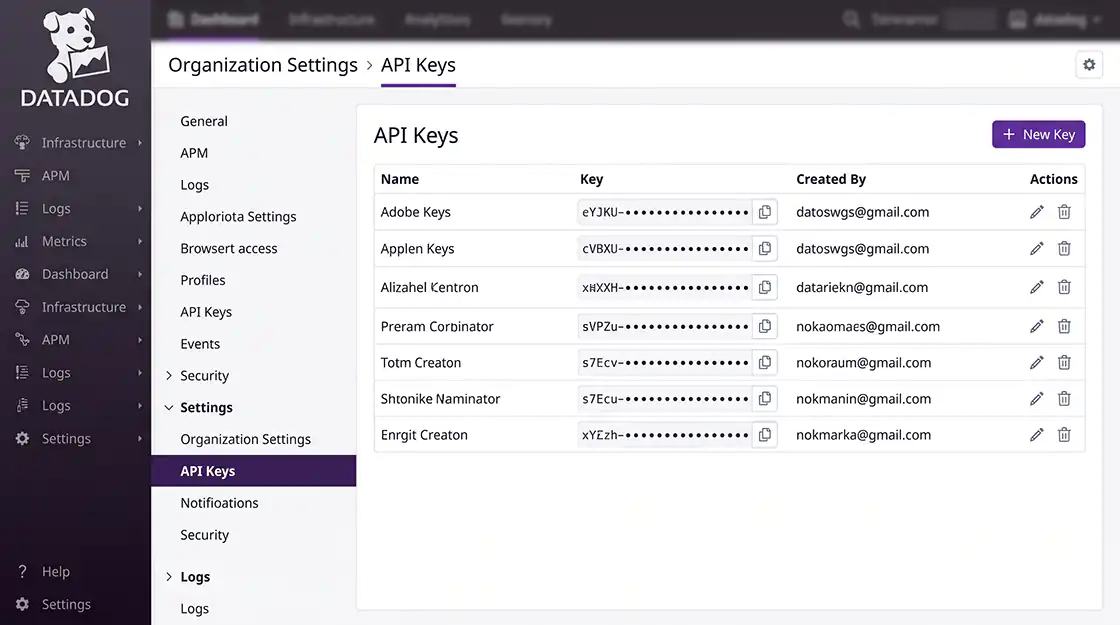
In Datadog, click the avatar in the lower-left corner and go to Organization Settings → API Keys.
Click + New Key, enter a name, create the key, and copy the displayed API Key.
Step 2. Obtain an Application Key
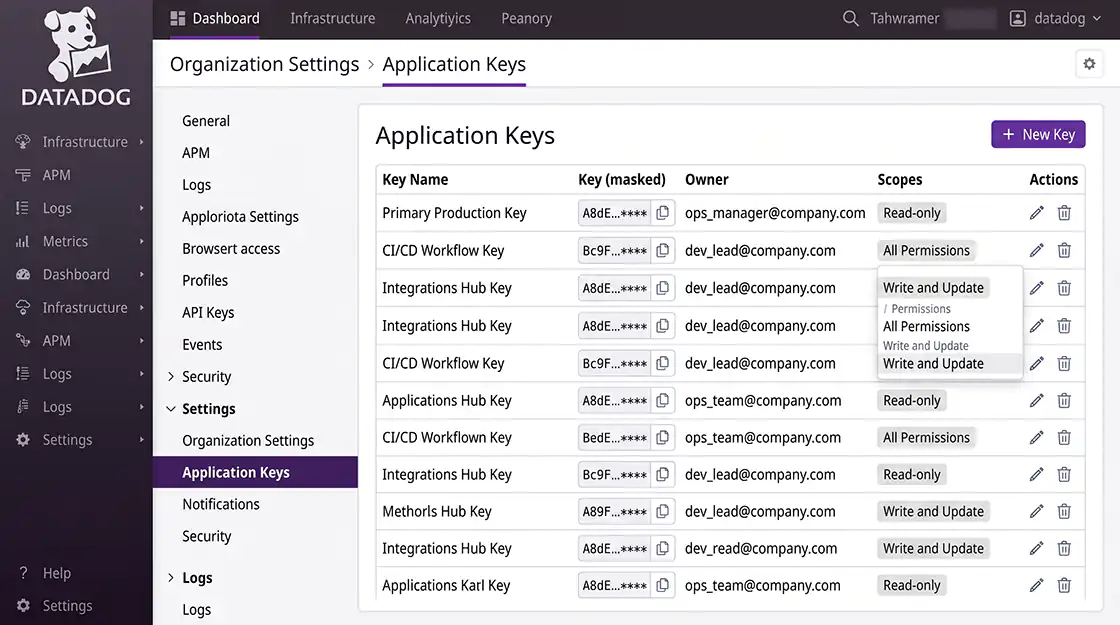
Go to Organization Settings → Application Keys, click + New Key, enter a name, and copy the Application Key.
The Application Key has the permissions of the user who created it, and you can specify a Scope when necessary to minimize access permissions.
ℹ️ API Keys and Application Keys are equivalent to passwords, so make sure they are not exposed in public repositories or external documents. If they are exposed, delete the affected keys and create new ones.
Step 3. Check the Datadog Site
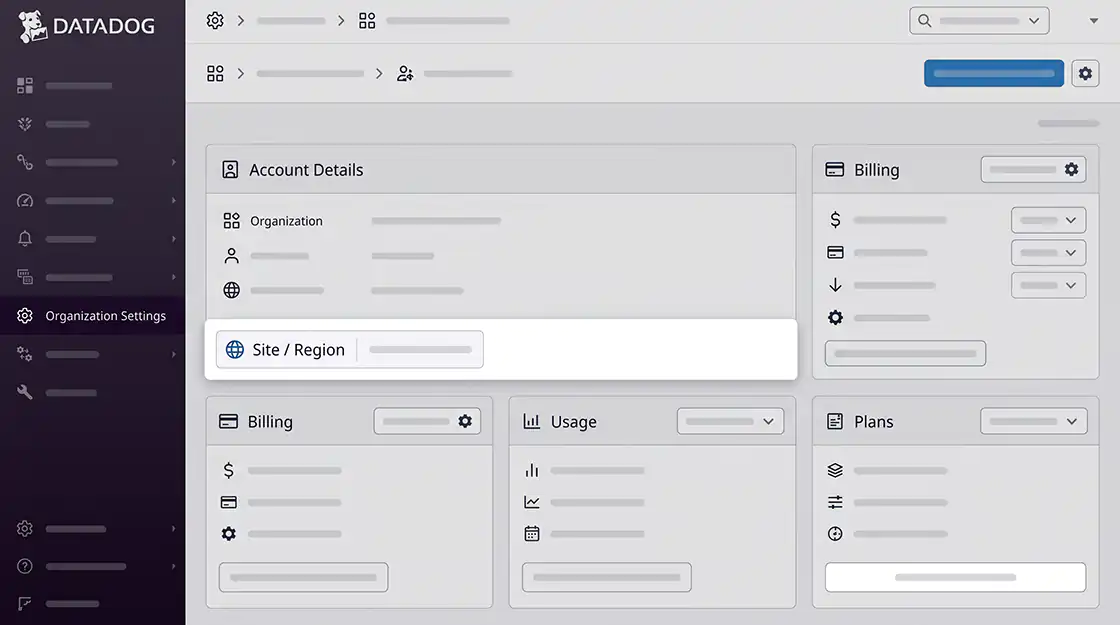
While logged in, check the Site in use through the browser address.
For example, app.datadoghq.com is US1, us3.datadoghq.com is US3, us5.datadoghq.com is US5, datadoghq.eu is EU, and ap1.datadoghq.com is AP1.
The confirmed Site must match the Datadog Site value in the product settings.
Checklist
- ✔ The API Key has been created.
- ✔ The Application Key has been created.
- ✔ The Datadog Site in use has been confirmed.
Configure Datadog Integration
Enter the created keys and Site in the product settings.
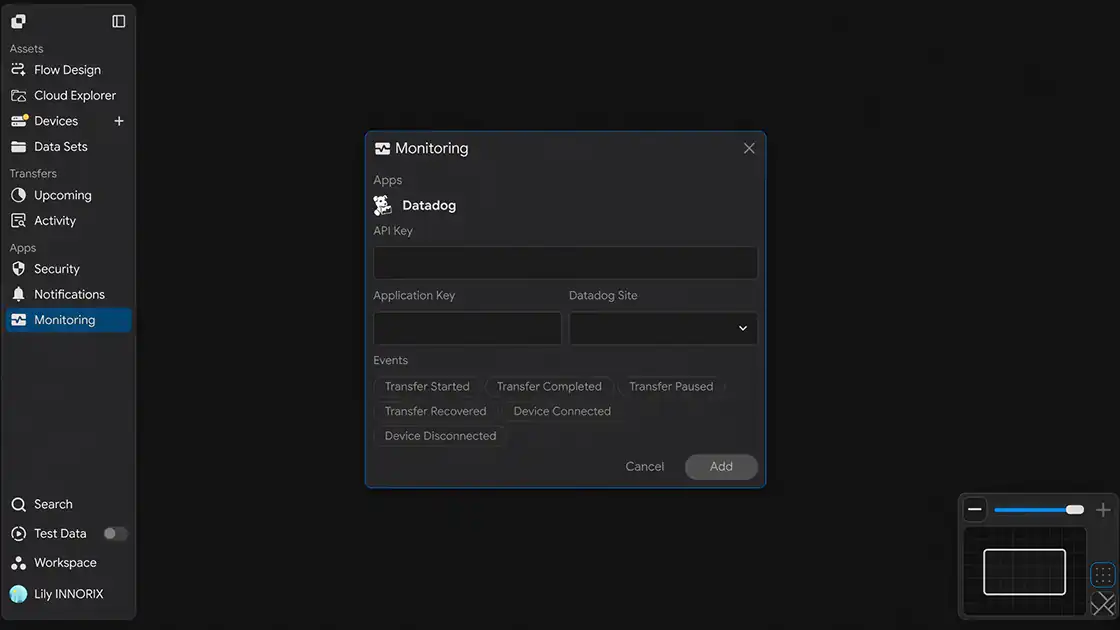
When you open the Monitoring settings window, the following screen is displayed.
Step 1. Enter the API Key
Enter the copied API Key in the API Key field.
Step 2. Enter the Application Key
Enter the copied Application Key in the Application Key field.
Step 3. Select the Datadog Site
Select the Site in use from the Datadog Site dropdown.
It must match the Site where the keys were created.
Step 4. Select Events
Select the events to monitor under Events.
You can select multiple events, and events are sent to Datadog only when the selected events occur.
| Event | When It Occurs |
|---|---|
| Transfer Started | When the transfer task starts |
| Transfer Completed | When the transfer is completed successfully |
| Transfer Paused | When the transfer is temporarily paused |
| Transfer Recovered | When the transfer is automatically recovered and resumed after an interruption or error |
| Device Connected | When a device is connected |
| Device Disconnected | When a device is disconnected |
Step 5. Save the Settings
After completing the input, click Add to save the integration.
Checklist
- ✔ The API Key and Application Key have been entered.
- ✔ The Datadog Site has been selected.
- ✔ The events to monitor have been selected.
Verify the Integration
Verify that the settings are working correctly.
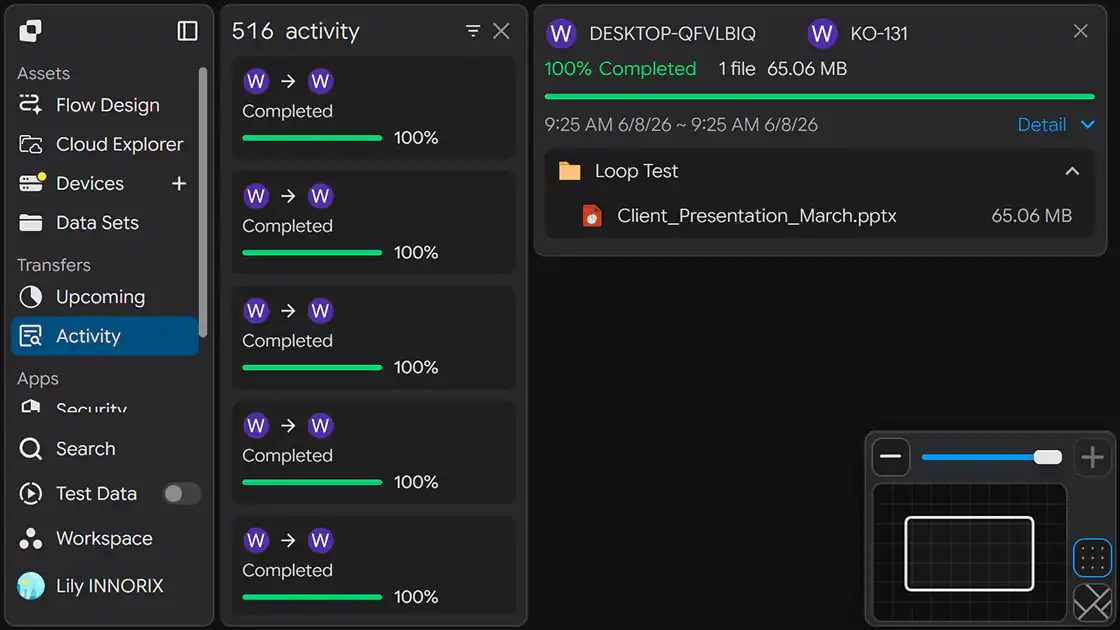
Step 1. Trigger a Test Event
Run an actual transfer task or trigger one of the selected events.
Step 2. Check Datadog
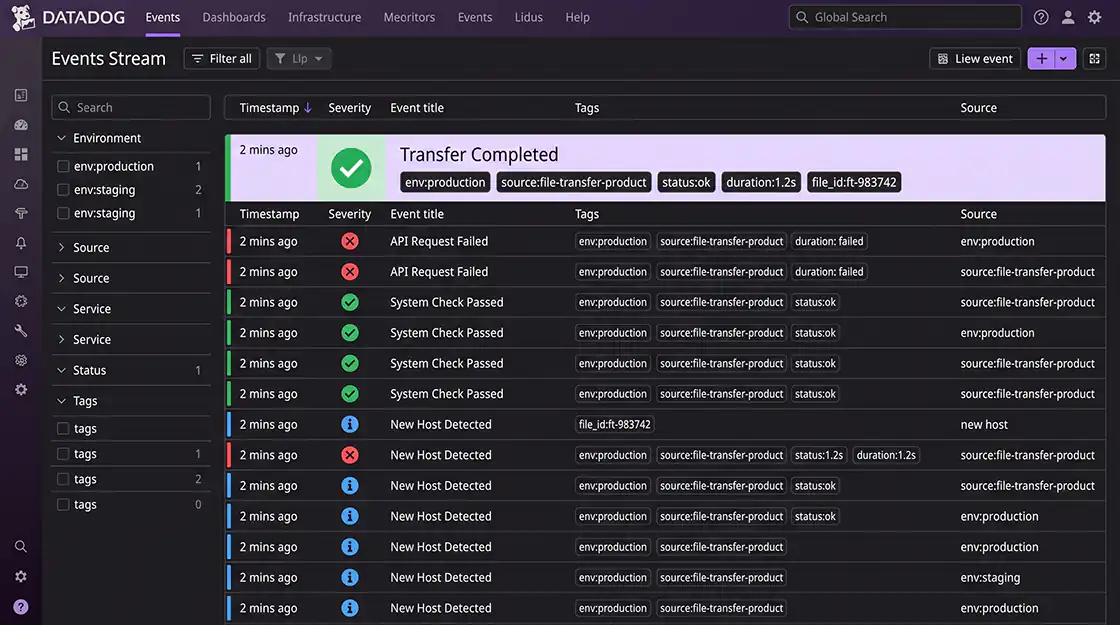
Check whether the event was received in Datadog's Event Stream or Dashboard.
Checklist
- ✔ The event has arrived in Datadog.
- ✔ The triggered event was delivered successfully.
Setup Complete
Once the settings are saved, the integration is applied.
After that, an event is automatically sent to Datadog whenever the selected events occur.
Troubleshooting
If events are not displayed in Datadog, check the following items.
| Issue | Checklist |
|---|---|
| Events are not displayed | Check whether the API Key, Application Key, and Datadog Site are correct and whether there are leading or trailing spaces or missing characters. |
| An authentication error occurs | Check whether the API Key and Application Key are valid and have not been deleted or re-created. |
| Site mismatch | Check whether the Site where the keys were created matches the Datadog Site in the product settings (for example, keys for a US organization cannot be used with the EU Site). |
| Insufficient Application Key permissions | Check whether the required permissions (Scope) have been granted to the Application Key. |
| Integration fails in a closed network | Check whether outbound communication to the API endpoint (HTTPS 443) of the selected Datadog Site is allowed by the firewall or proxy. |