Overview
You can configure Sentry integration to send and monitor file transfer tasks and device status changes.
After completing the integration, events are sent to Sentry whenever designated events occur, such as a transfer being Started (Transfer Started) or Completed (Transfer Completed), or a device being Connected (Device Connected) or Disconnected (Device Disconnected). You can view them separately by the specified Environment.
The entire process consists of two steps: ① Check the Sentry DSN → ② Configure the integration in the product.
Prerequisites
Before you begin, check the following.
| Item | Description |
|---|---|
| Sentry project | Permission to access the Sentry project that will collect events and view its DSN is required. |
| Environment Name | Decide in advance on the environment name (for example, production) used to distinguish events. |
| Network | Outbound HTTPS communication to the DSN Ingest endpoint (for example, oXXX.ingest.sentry.io, 443) must be allowed from the environment where the product is installed. |
Check the Sentry DSN and Define an Environment Name
To send events to Sentry, check the project's DSN and define the Environment Name used to distinguish events.
Step 1. Check the DSN
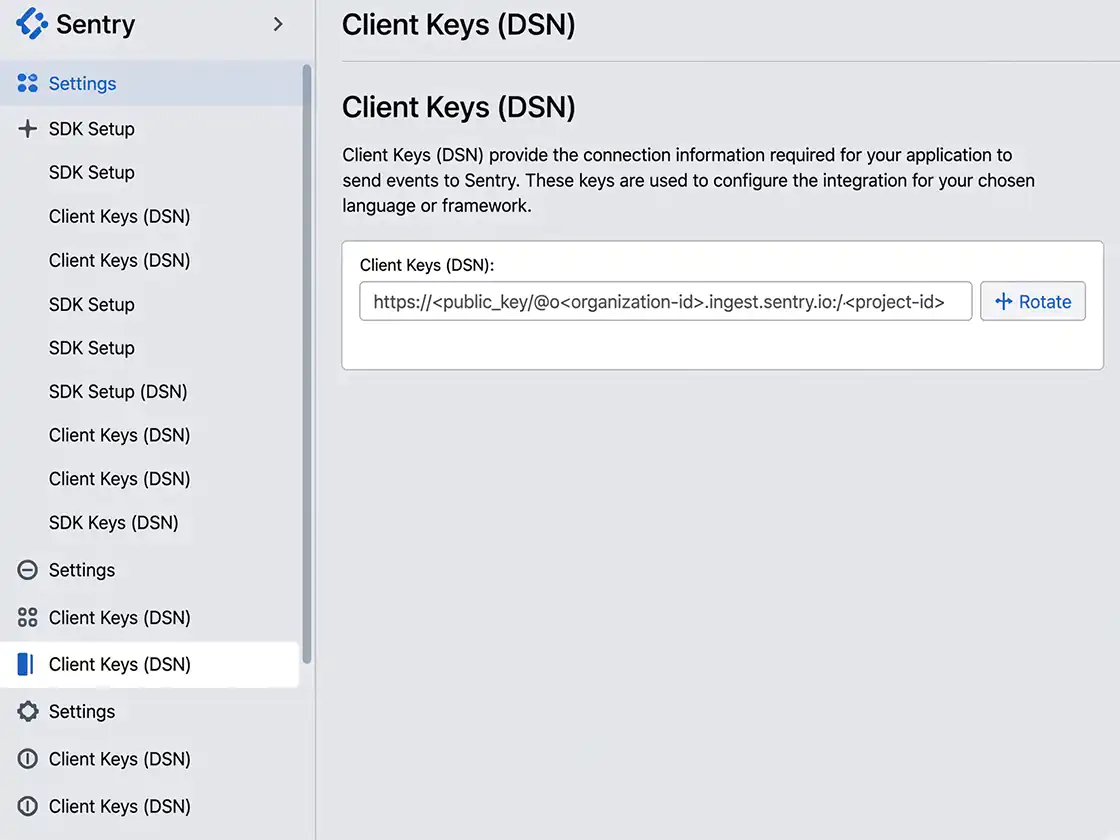
In Sentry, go to Settings → SDK Setup → Client Keys (DSN) for the target project and copy the DSN.
The DSN format is as follows.
https://<public_key>@o<Organization ID>.ingest.sentry.io/<Project ID>
ℹ️ The DSN is a public key that allows only event submission, but if it is exposed externally, unwanted events may be sent. If necessary, you can issue a new DSN using Rotate.
Step 2. Define an Environment Name
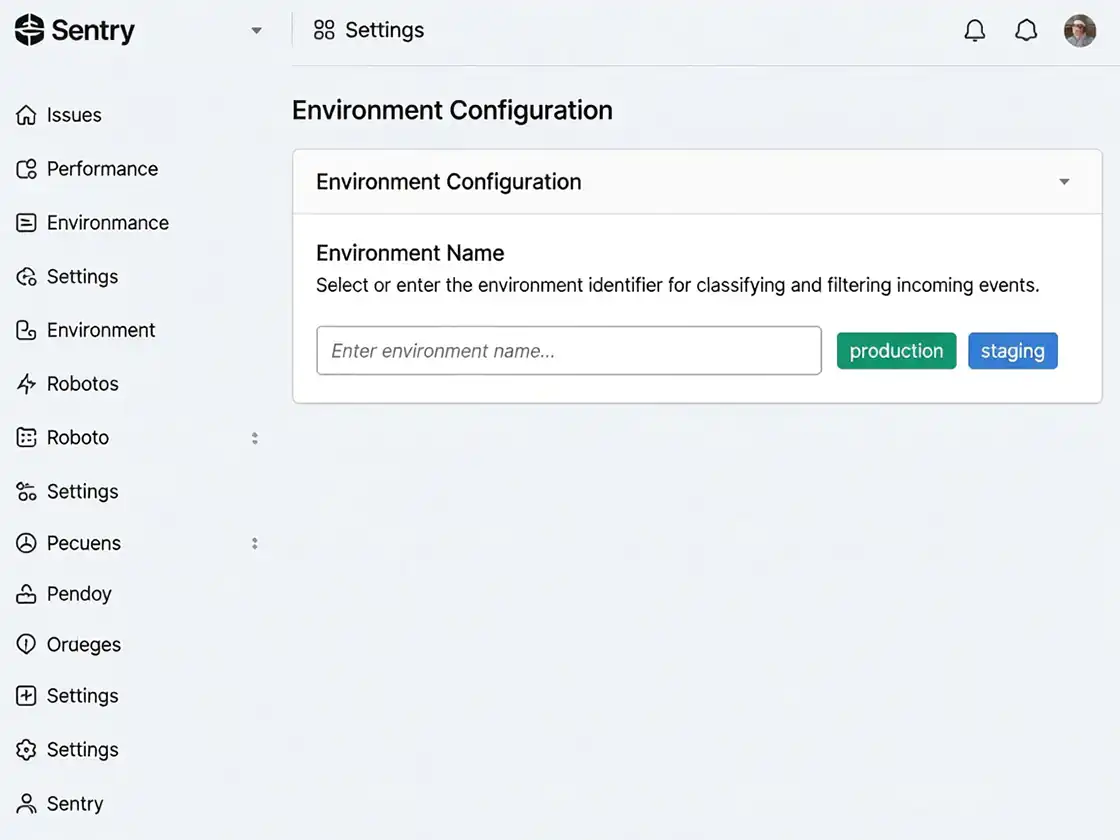
Define the Environment Name used to distinguish events.
Example:
production
staging
You do not need to create the environment separately. When events are collected with that name, it is automatically displayed in Sentry.
Checklist
- ✔ The project's DSN has been confirmed.
- ✔ The Environment Name to use has been defined.
Configure Sentry Integration
Enter the confirmed DSN and Environment Name in the product.
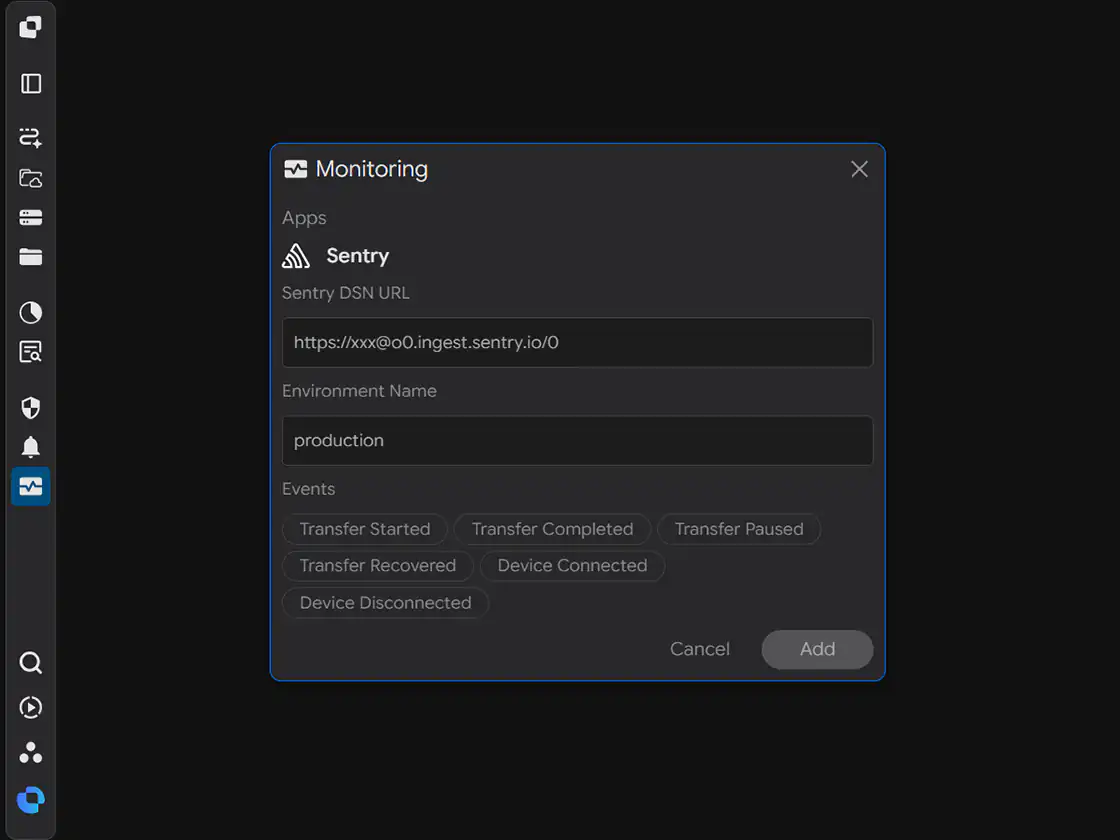
Monitoring When you open the settings window, the following screen is displayed.
Step 1. Enter the Sentry DSN URL
Enter the confirmed DSN in the Sentry DSN URL field.
Step 2. Enter the Environment Name
Enter the environment name to use in the Environment Name field.
Example:
production
Step 3. Select Events
Select the events to monitor under Events.
You can select multiple events, and events are sent to Sentry only when the selected events occur.
| Event | When It Occurs |
|---|---|
| Transfer Started | When the transfer task starts |
| Transfer Completed | When the transfer task is completed successfully |
| Transfer Paused | When the transfer task is temporarily paused |
| Transfer Recovered | When the transfer is automatically recovered and resumed after an interruption or error |
| Device Connected | When a device is connected |
| Device Disconnected | When a device is disconnected |
Step 4. Save the Settings
After completing the input, click Add to save the integration.
Checklist
- ✔ The Sentry DSN URL has been entered.
- ✔ The Environment Name has been entered.
- ✔ The events to monitor have been selected.
Verify the Integration
Verify that the settings are working correctly.
Step 1. Trigger a Test Event
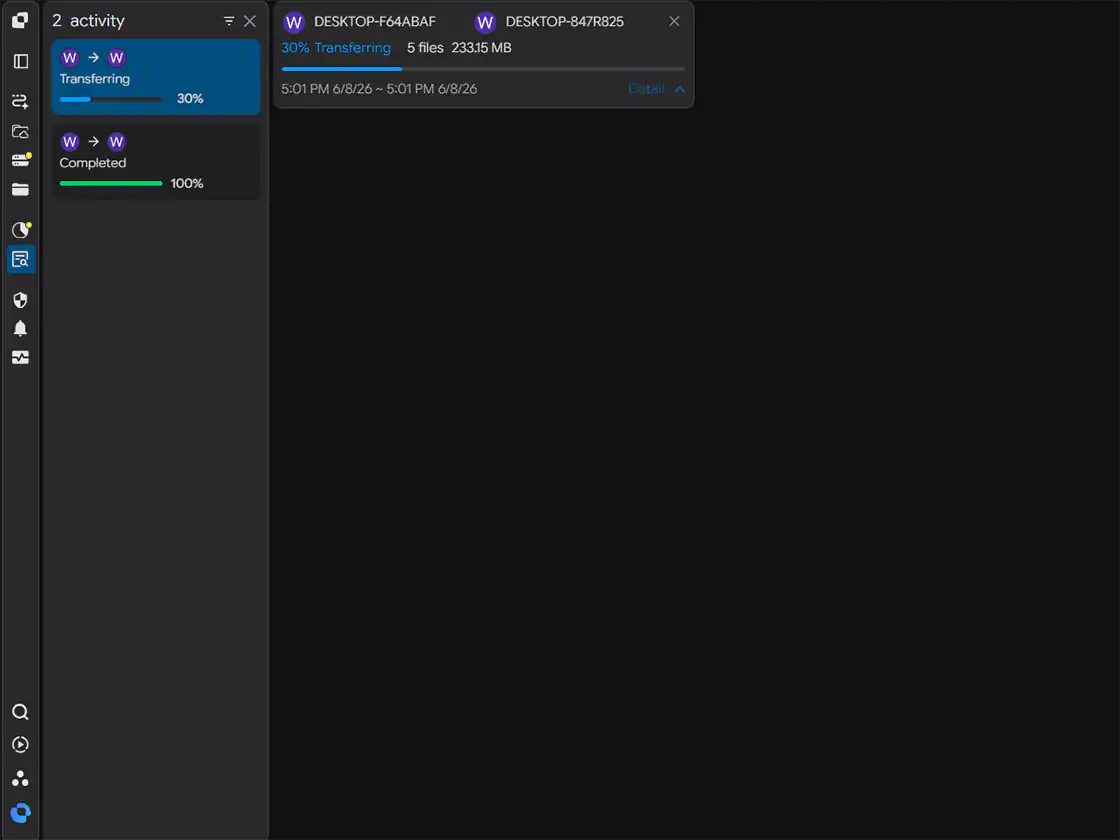
Run an actual transfer task or trigger one of the selected events.
Step 2. Check Sentry
Check whether events have been collected successfully in Sentry and are displayed separately by the specified Environment.
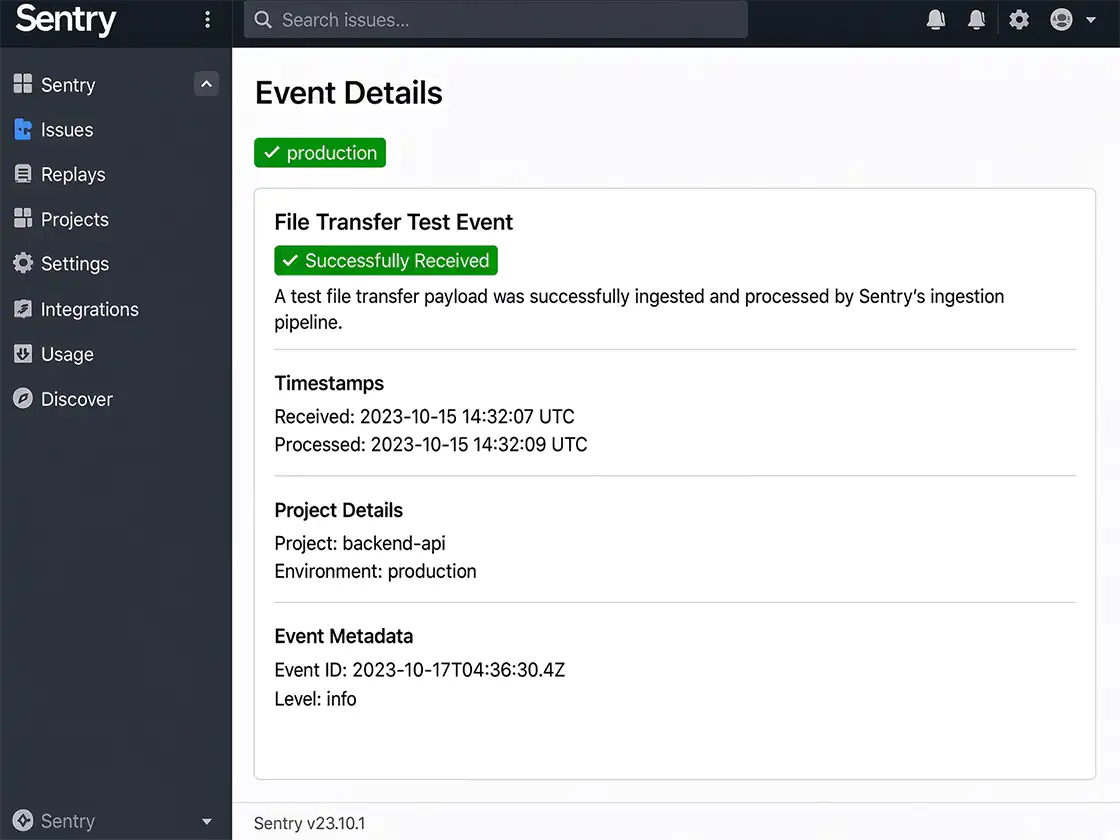
Checklist
- ✔ An event has arrived in Sentry.
- ✔ Events are displayed separately by the specified Environment.
Setup Complete
Once the settings are saved, the integration is applied.
After that, events are automatically sent to Sentry whenever the selected events occur.
Troubleshooting
| Issue | Checklist |
|---|---|
| Events are not displayed | Check whether the Sentry DSN URL is correct and whether there are leading or trailing spaces or missing characters. |
| Project cannot be found | Check whether the DSN belongs to the target project and has not been rotated or disabled. |
| Events are not separated by Environment | Check whether the Environment Name was entered correctly. |
| Some events are missing | Check whether the Client Keys Rate Limit has been reached. |
| Integration fails in a closed network | Check whether outbound communication to the DSN Ingest endpoint (for example, oXXX.ingest.sentry.io, 443) is allowed by the firewall or proxy. |