
Overview
You can configure Zoho integration to send and monitor file transfer tasks and device status changes.
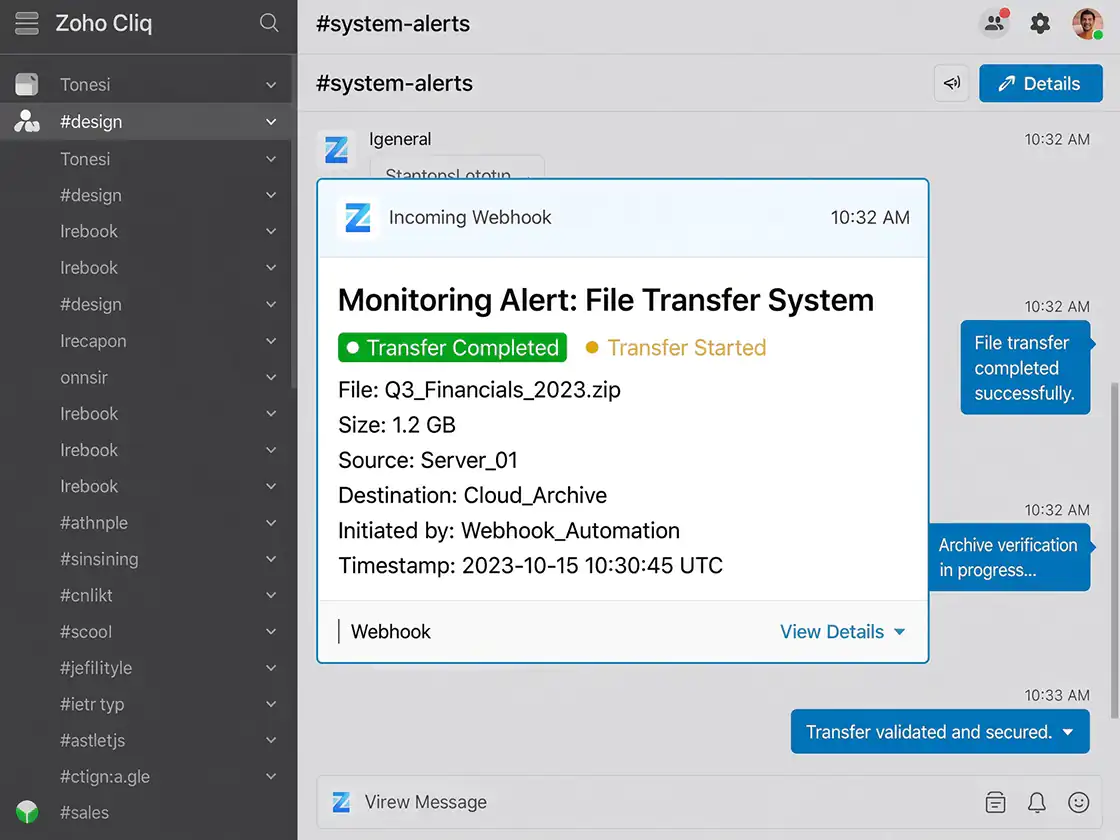
After completing the integration, notifications are automatically sent to the Zoho destination connected through the incoming Webhook (for example, a Zoho Cliq channel) whenever designated events occur, such as a transfer being Started (Transfer Started) or Completed (Transfer Completed), or a device being Connected (Device Connected) or Disconnected (Device Disconnected).
The entire process consists of two steps: ① Obtain a Zoho Incoming Webhook URL → ② Configure the integration in the product.
Prerequisites
Before you begin, check the following.
| Item | Description |
|---|---|
| Zoho account | A Zoho account that can create an incoming Webhook is required. (For Zoho Cliq, channel administrator permission is required.) |
| Target channel | Prepare the Zoho Cliq channel that will receive notifications in advance. |
| Network | Outbound HTTPS communication to the Zoho Webhook endpoint (for example, cliq.zoho.com, 443) must be allowed from the environment where the product is installed. |
Obtain a Zoho Incoming Webhook URL
To send notifications to Zoho, you must obtain a Webhook URL that posts messages to the target destination.
Step 1. Create an Incoming Webhook
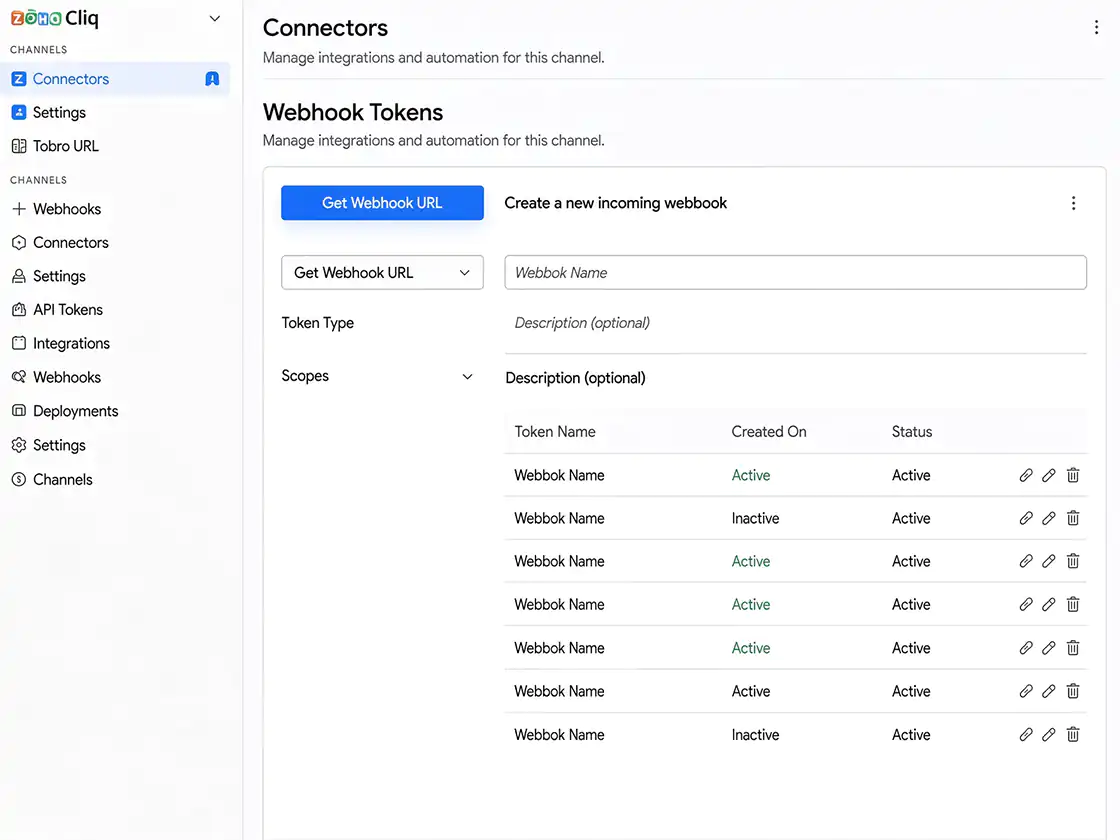
In Zoho Cliq, open the channel that will receive notifications and create a Webhook from the Connectors tab. (Only channel administrators can configure it.)
Alternatively, select Get Webhook URL on the Webhook Tokens page, then specify Channels and the target channel.
Step 2. Copy the Webhook URL
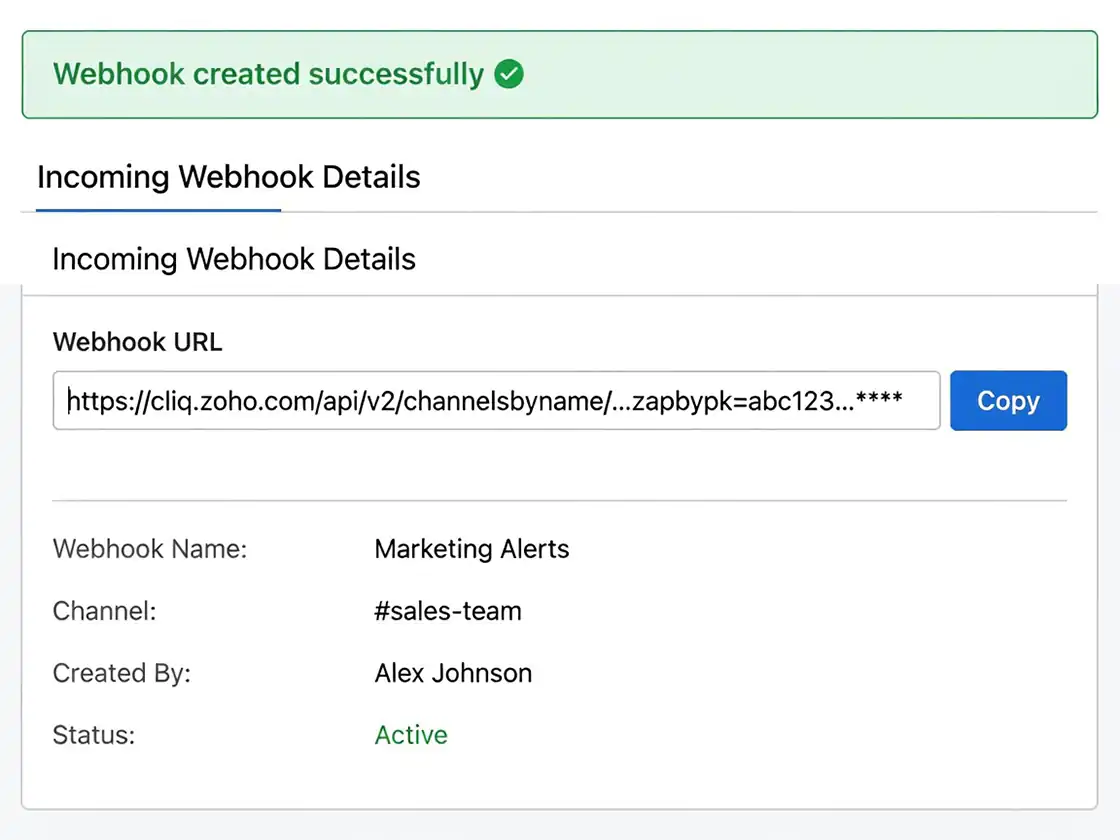
Copy the generated Webhook URL.
Example:
https://cliq.zoho.com/api/v2/channelsbyname/<Channel Name>/message?zapikey=<Token>
ℹ️ The zapikey included in the URL has the same level of access as a password, so make sure it is not exposed externally. If it is exposed, issue a new Webhook Token.
Checklist
- ✔ An incoming Webhook has been created.
- ✔ The Webhook URL has been copied.
Configure Zoho Integration
Enter the issued Webhook URL in the product.
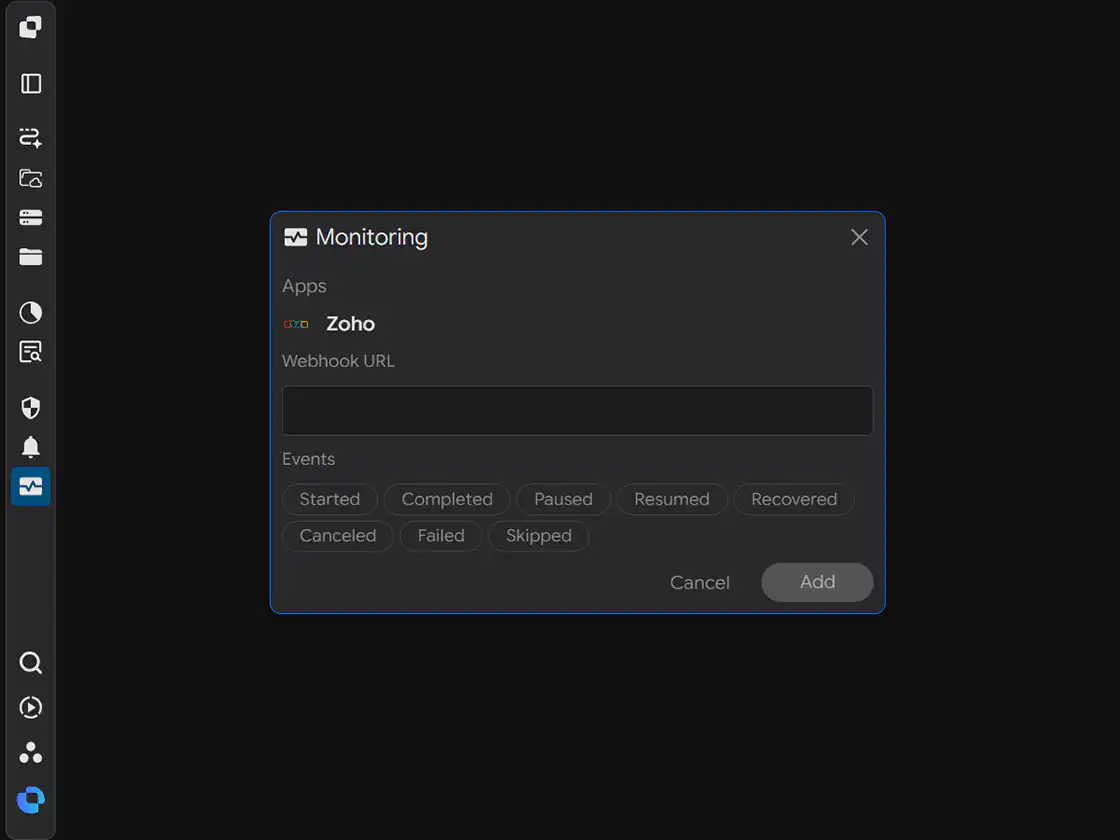
Monitoring When you open the settings window, the following screen is displayed.
Step 1. Enter the Webhook URL
Enter the issued URL in the Webhook URL field.
Step 2. Select Events
Select the events to monitor under Events.
You can select multiple events, and notifications are sent to Zoho only when the selected events occur.
| Event | When It Occurs |
|---|---|
| Transfer Started | When the transfer task starts |
| Transfer Completed | When the transfer task is completed successfully |
| Transfer Paused | When the transfer task is temporarily paused |
| Transfer Recovered | When the transfer is automatically recovered and resumed after an interruption or error |
| Device Connected | When a device is connected |
| Device Disconnected | When a device is disconnected |
Step 3. Save the Settings
After completing the input, click Add to save the integration.
Checklist
- ✔ The Webhook URL has been entered.
- ✔ The events to monitor have been selected.
Verify the Integration
Verify that the settings are working correctly.
Step 1. Trigger a Test Event
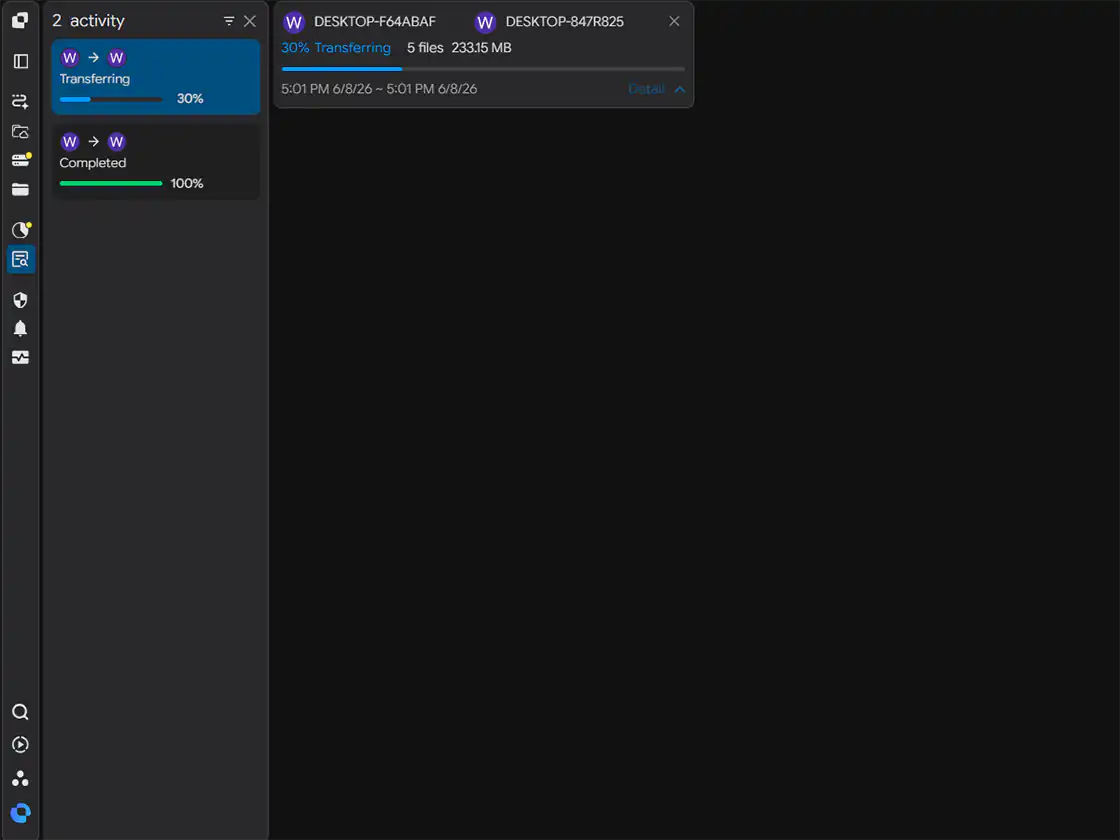
Run an actual transfer task or trigger one of the selected events.
Step 2. Check Zoho
Check whether a notification message has arrived in the target Zoho Cliq channel.
Checklist
- ✔ A notification has arrived at the Zoho destination.
- ✔ The triggered event was delivered successfully.
Setup Complete
Once the settings are saved, the integration is applied.
After that, notifications are automatically sent to the Zoho destination whenever the selected events occur.
Troubleshooting
| Issue | Checklist |
|---|---|
| Notifications do not arrive | Check whether the Webhook URL is correct (including zapikey) and whether there are leading or trailing spaces or missing characters. |
| A 401 authentication error occurs | Check whether zapikey is valid and issue a new one if necessary. |
| Messages are not posted | Check whether the Webhook is configured to post to the target channel (channel administrator settings). |
| Integration fails in a closed network | Check whether outbound communication to the Zoho Webhook endpoint (for example, cliq.zoho.com, 443) is allowed by the firewall or proxy. |