
EXABYTER
Transfer large files quickly and reliably over the web.
From a single large file to massive numbers of files and folders, INNORIX EX reliably completes uploads and downloads initiated from web applications and, when needed, connects those files to storage and downstream systems.
WEB FILE TRANSFER
Web uploads and downloads are transfers, too.
In a typical web environment where small files are exchanged quickly, file transfer can appear to be little more than a request.
That changes as files grow larger and transfers run longer. A user's network may change, connections may be interrupted, many users may access the service at the same time, and restarting a failed transfer from the beginning becomes increasingly costly.
INNORIX EX handles web file transfer not simply as an Upload Request, but as a persistent Transfer from start to completion. It maintains transfer state, resumes interrupted transfers, and continues until the file has actually reached its destination.
Standard Web Upload vs. Large File Transfer
| Standard Web Upload | INNORIX EX | |
|---|---|---|
| Processing model | Request | Transfer |
| Long-running transfer | Designed for short requests | Long-running Transfer |
| Connection interruption | Retry or retransmit | Resume / Recovery |
| File scale | Typical files | Large files and massive file sets |
| State | Progress-oriented | Persistent Transfer State |
| Completion | Request result | Actual Transfer completion |
| Scaling | Coupled with Web Application | File data path can be separated |
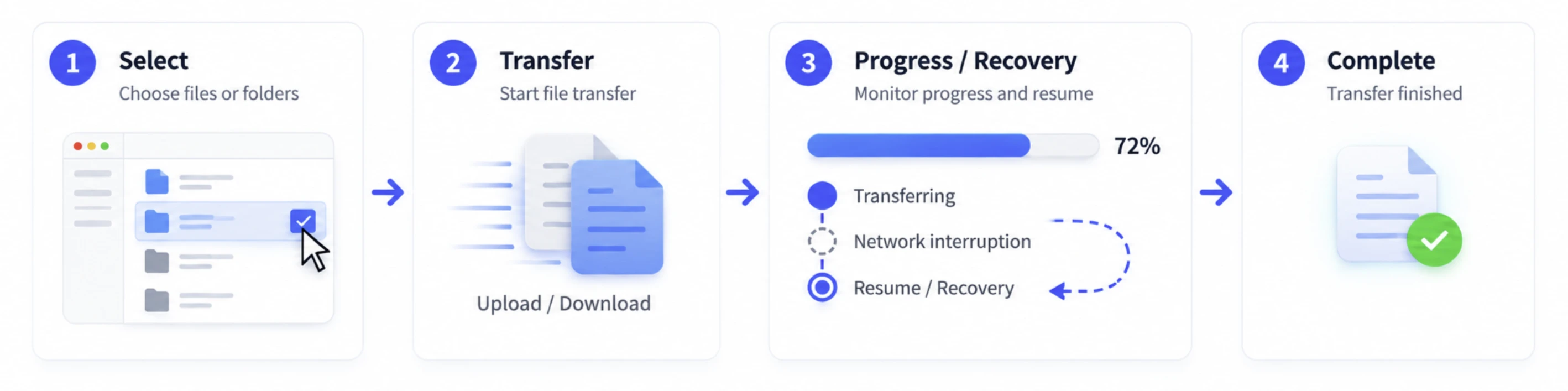
LARGE FILES & MANY FILES
Transfer one massive file or millions of files the same way.
When files reach tens of gigabytes or more, transfer duration itself becomes an operational factor. A user's network may change, the connection between browser and server may be interrupted, and retransmitting the entire file after every failure becomes increasingly impractical as file size grows.
Real-world business data is not always a single large file, either. Images, research data, manufacturing data, and media projects can consist of huge numbers of files organized across multiple levels of folders.
INNORIX EX handles large individual files, massive numbers of small files, folders, and datasets containing files of different sizes through one consistent web transfer experience. If a transfer is interrupted, it can continue without retransmitting all data already delivered.
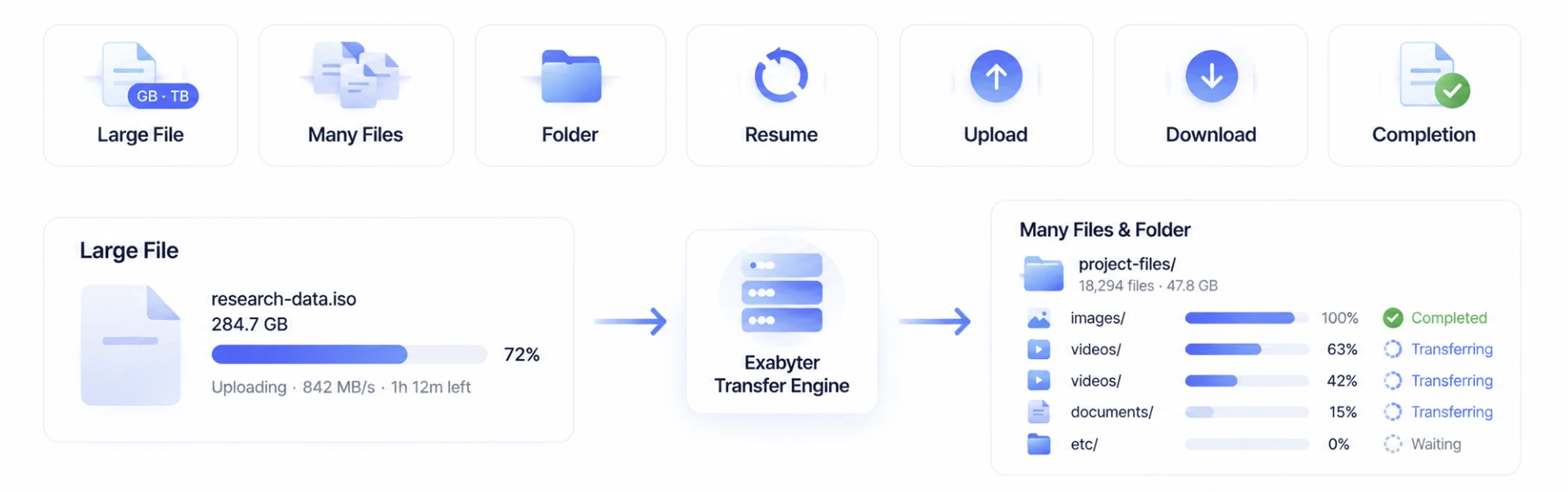
HIGH-SPEED & RELIABLE TRANSFER
The same network speed does not always produce the same file transfer speed.
Even when sufficient network bandwidth is available, long distance, higher Latency, and Packet Loss can prevent a file transfer from fully utilizing that bandwidth. With large files that remain in transfer for extended periods, these differences directly affect total completion time.
INNORIX EX optimizes file transfer for real network conditions to make efficient use of available bandwidth. Even when temporary connection issues or network changes occur during a transfer, it maintains transfer state and recovers the session, focusing on completing the actual file transfer—not simply achieving a momentary peak speed.
An interruption does not mean starting over.
With large files, the amount of data that must be sent again after a failure can be a greater problem than the failure itself.
By maintaining Transfer State and continuing from the interrupted point, INNORIX EX helps prevent a temporary connection loss from turning into a complete retransmission.
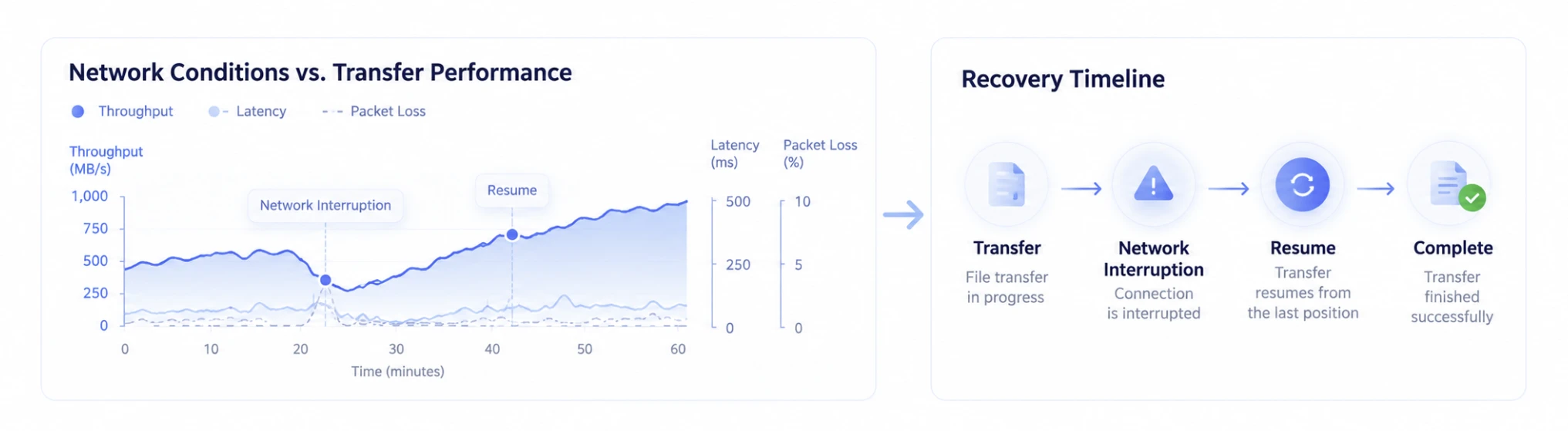
WEB SERVICE AT SCALE
Keep every transfer reliable as the number of users grows.
For enterprise web services, how many users upload and download at the same time can matter just as much as the size of a single user's file.
When large-file transfer is tightly coupled with web application processing, growing File Traffic can become a scaling burden for the entire web service. When many long-running Transfers occur simultaneously, each Transfer must also maintain its own progress, failure, and recovery state independently.
INNORIX EX handles each user's file transfer as an independent Transfer. Depending on the service architecture, the web application can handle authentication and business processing while the actual file data travels through a separate Transfer path, enabling Web Traffic and File Traffic to scale according to their own requirements.
One large transfer and thousands of concurrent transfers are different problems.
- Persistent Transfer State for each user
- Concurrent Upload / Download
- Independent progress and recovery for long-running Transfers
- Traffic and concurrency control
- Separation of the web application and file data paths
- Scalable architecture for increasing transfer volume
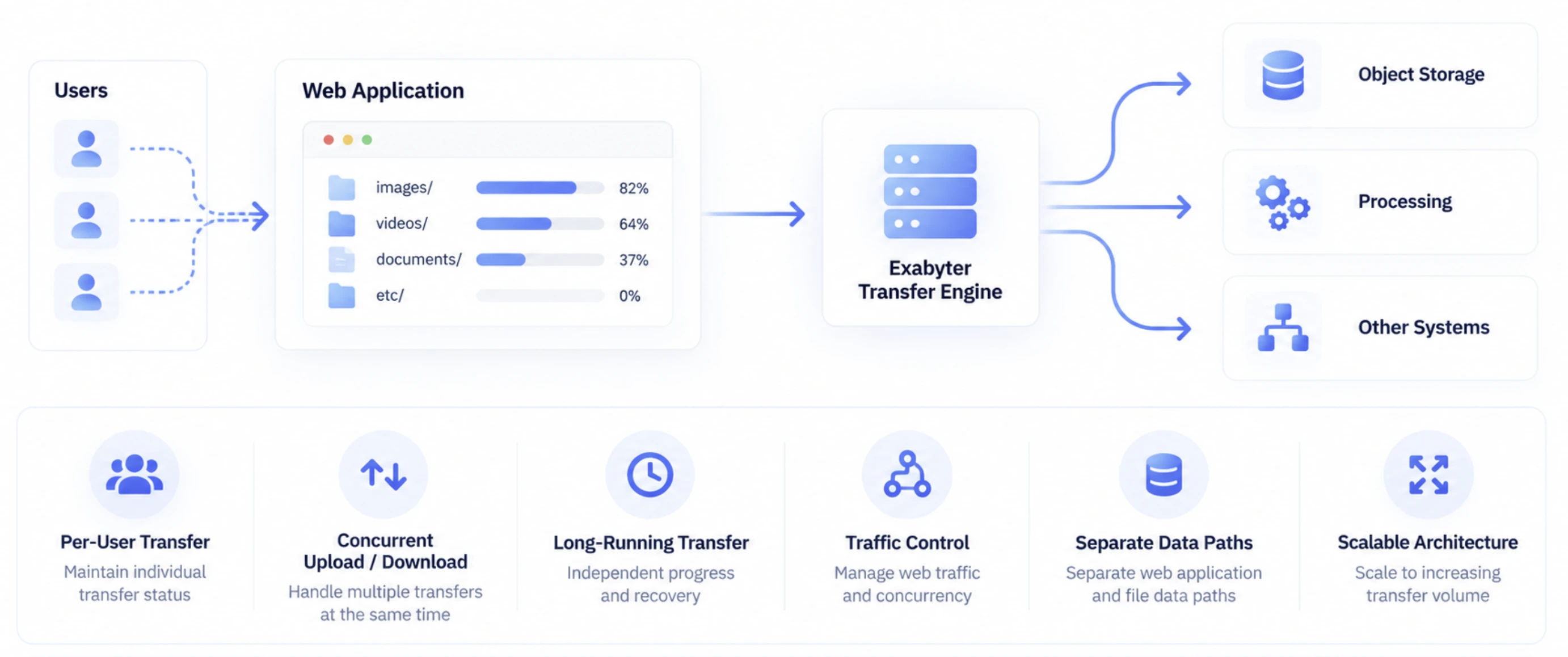
ARCHITECTURE
Keep your current system or separate the file data path.
Enterprise web services are not all built the same way.
Existing business systems often operate with Web/WAS and file storage within a single application architecture. In newer cloud services and large-scale data environments, the application may handle authentication and business logic while large-file storage and transfer use a separate data path.
INNORIX EX does not require one architecture. You can add large-file upload and download to an existing web system, or separate the web application from the actual file data path around Object Storage.
Connect to an Existing Web Application
Keep the existing Web Server, application authentication, authorization, database, business logic, and storage structure while adding large-file transfer capabilities.

Connect to Object Storage
The web application can handle authentication and business processing while large-file data travels through a separate Transfer path to Object Storage.

The objective is not to choose whichever architecture appears newer. What matters is selecting the transfer architecture that fits your existing system, data scale, service structure, and the destinations files need to reach next.
BEYOND UPLOAD
Uploaded files can keep moving to their next destination.
A web upload does not always end when a file reaches Storage.
A file uploaded by a user may need to move to a processing server, be used by an AI system, or be delivered to servers and storage in another location. In the opposite direction, files generated by equipment or other systems may need to be collected and made available for web download.
Once a file reaches Object Storage, it can continue to the required server, storage, or downstream system. Files collected elsewhere can also be connected to a web download, allowing web transfer to become either the starting point or the final delivery point of a larger data flow.
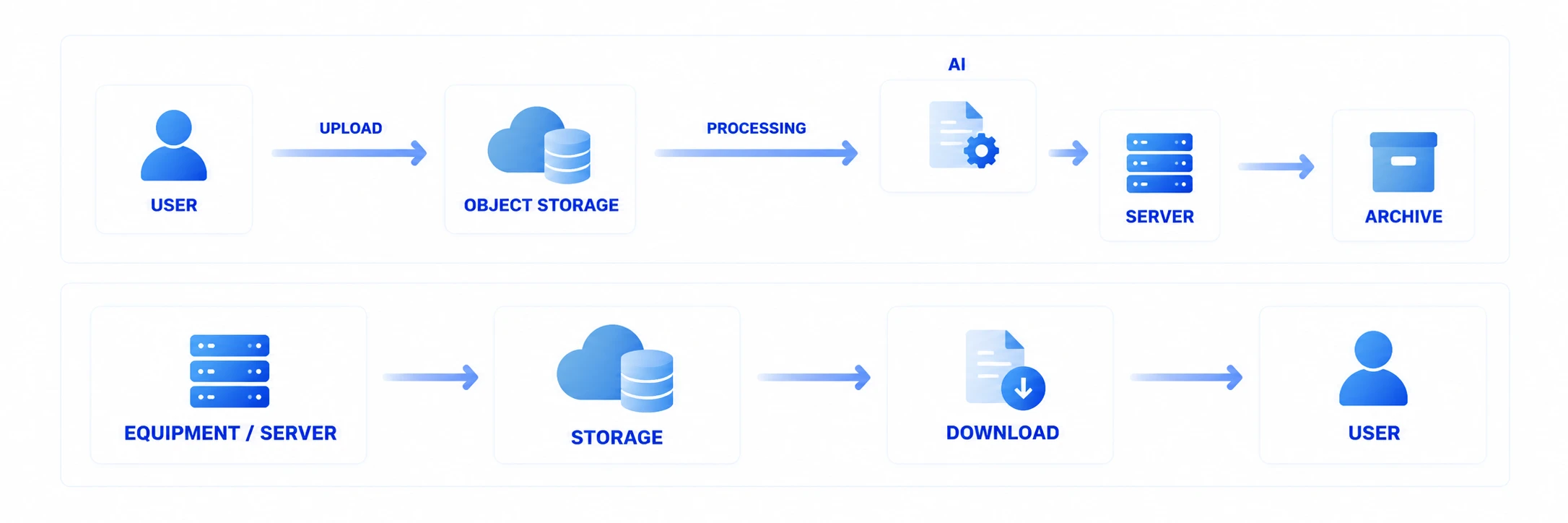
This architecture connects file transfers initiated on the web with distribution, collection, and processing across other systems.
BUSINESS INTEGRATION
Process files and business data together.
Enterprise file uploads rarely exist as isolated tasks.
Files often need to be associated with business data such as user information, document numbers, projects, orders, or inspection results. The completion of a file transfer may also trigger the next business process.
INNORIX EX can connect the start, progress, and completion result of a file transfer with the business logic of the web application. The existing application continues to manage authentication, authorization, Metadata, and business status, while file data can be processed according to Transfer State and results.
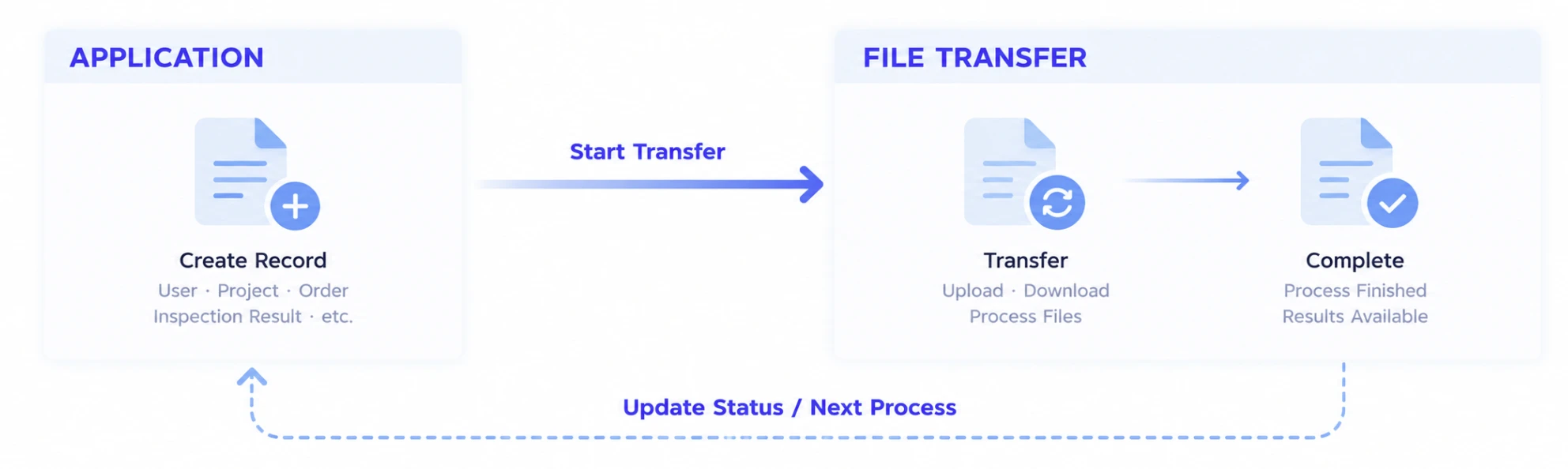
This makes it possible to build multi-stage workflows such as Upload → Processing → Transfer → Download.
TRANSFER VISIBILITY
See the status and result of every transfer you start.
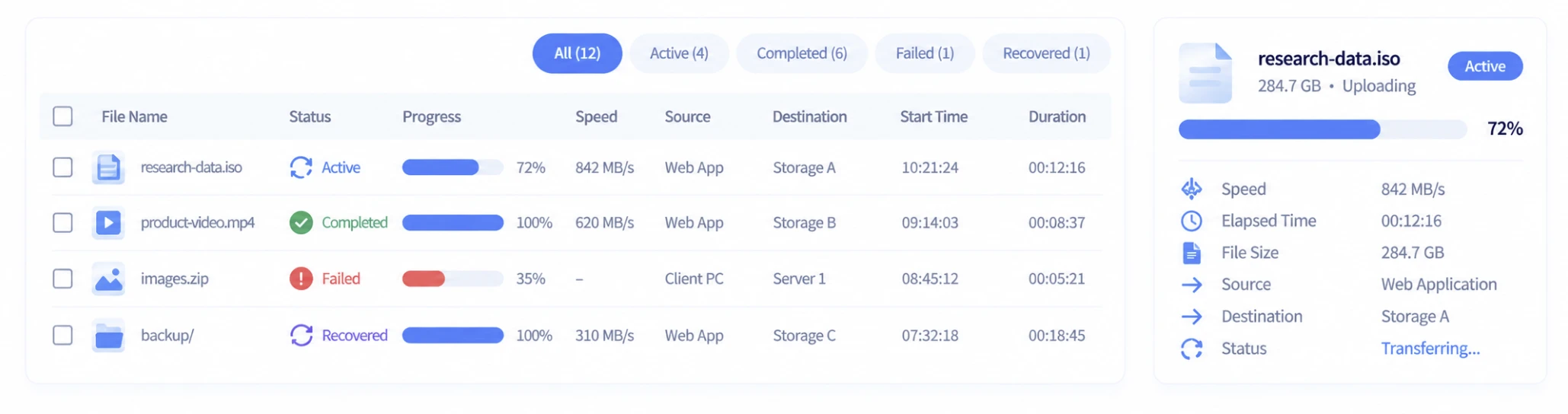
Once file transfer becomes part of a business process, a Progress Bar alone is not enough. You may need to know which Transfers are active, which have completed, and where a problem occurred.
In large-scale operational environments, Transfer progress, completion results, failures, recoveries, and historical records can be reviewed and tracked. When files initiated on the web continue to other servers, storage, or equipment, those file flows can also be incorporated into a broader operational environment.
USE CASES
Use INNORIX EX wherever files move through the web.
Public & Enterprise Business Systems
Strengthen file transfer in existing web workflows such as applications, data submissions, document registration, and large-file downloads.
Media
Upload high-resolution video and large production datasets through the web and download completed deliverables.
Research & Science
Transfer large research datasets, massive numbers of result files, and folder-based datasets.
Manufacturing
Move design, inspection, and production data through web systems and connect it to the required servers and storage.
AI & Data
Upload Datasets and connect them to Object Storage, processing systems, and downstream data Workflows.
Customer & Partner Services
Enable external users to upload large files directly and download processed results through a web service.
EXPLORE EXABYTER
Explore the area that matters to you.
Large & Mass File Transfer
Learn how to reliably transfer large files, massive numbers of files, folders, and mixed datasets over the web.
Read moreHigh-Speed & Reliable Transfer
See how large Transfers can be completed quickly and reliably across long-distance and unstable networks.
Read moreWeb Service at Scale
Learn how to design and scale web services as concurrent users and transfer volume increase.
Read moreArchitecture & Integration
Explore architectures ranging from existing Web Server environments to Object Storage, business systems, and downstream data Workflows.
Read moreOperations & Management
Learn how to monitor and operate Transfer status, results, failures, recoveries, and historical records at scale.
Read moreFrequently Asked Questions
How is large-file transfer over the web different from a standard web upload?
A standard web upload is well suited to environments where file delivery completes within a relatively short request. As files become larger and transfers run longer, connection interruptions, retransmission, persistent progress state, and actual completion become more important. INNORIX EX handles file upload and download as a long-running Transfer with persistent state.
Do I have to restart a large-file transfer from the beginning if it is interrupted?
An interrupted Transfer can continue based on its Transfer State instead of retransmitting all data that has already been delivered. The larger the file, the more important Resume and Recovery become in reducing total completion time and retransmitted Traffic.
Can INNORIX EX transfer massive numbers of files and folders as well as a single large file?
Yes. INNORIX EX can handle large individual files, large numbers of small files, folders, and datasets containing files of different sizes through a consistent web transfer experience.
Can INNORIX EX be integrated into an existing web system?
Yes. File transfer capabilities can be added while retaining the existing Web Server and application architecture. Depending on the service design, the web application and file data path can also be separated and connected to Object Storage.
Can an uploaded file continue to another server or system?
Yes. A file uploaded through the web does not have to stop at storage. It can be connected to a larger data flow that continues to processing servers, storage, or other systems. In the opposite direction, files generated or collected by other systems can also be made available to web users for download.
Considering web file transfer?
We'll help you review an Upload and Download setup that fits your current web service and file data environment.
- Review of your web Upload and Download environment
- Proposal for a large-file and high-file-count transfer setup
- Guidance on connecting storage and downstream systems