
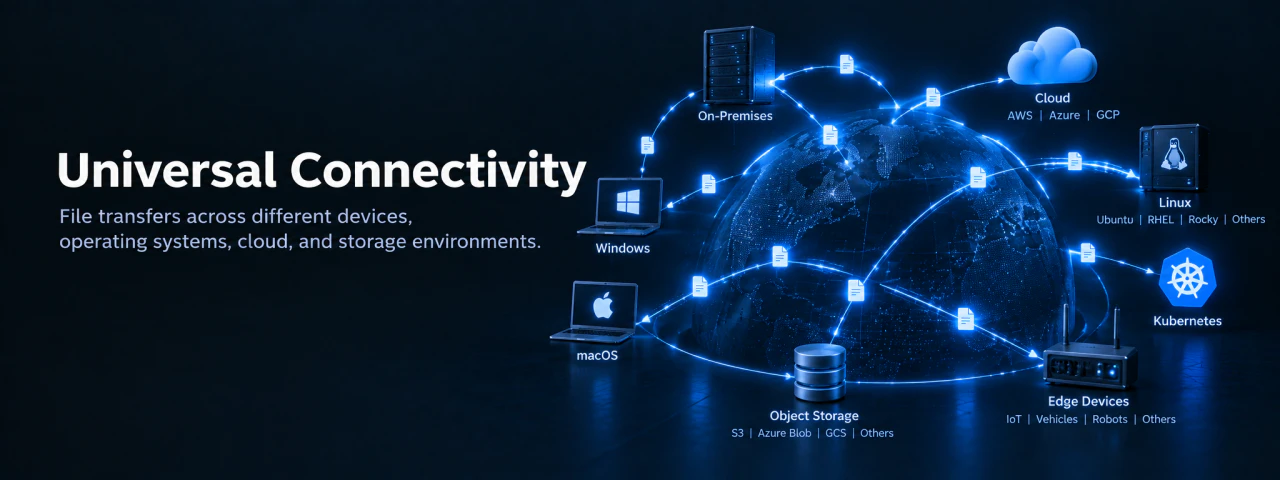
The Massive Barrier of Fragmented Platforms: The Dark Age of Data Transfer Caused by Disconnection Between OS and Cloud#
Identifying the technical disconnection where direct communication is impossible between different file systems and closed cloud storage environments.
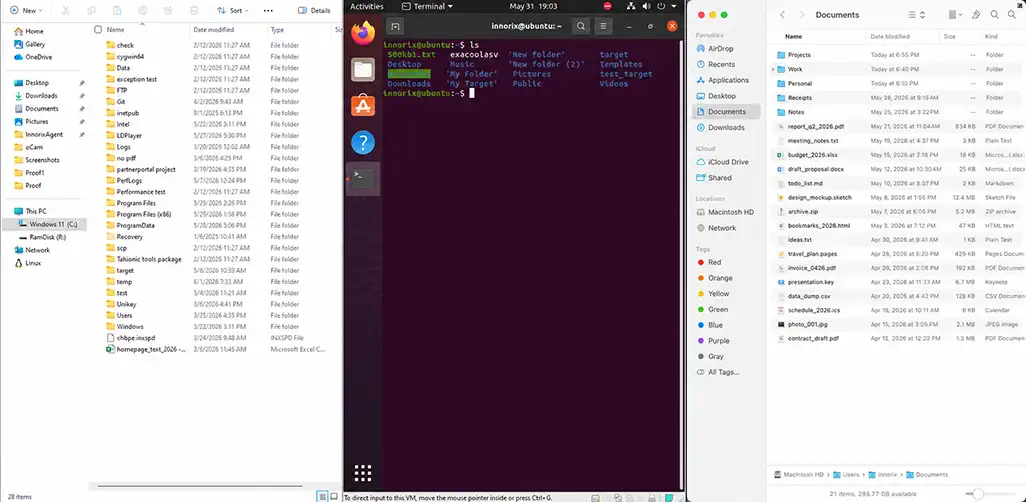 [OS Screen] Windows File Explorer, macOS Finder, and Linux Terminal displayed side by side, illustrating different file system structures and a fragmented environment that cannot be directly connected using conventional methods
| Item (Aspect) | Core Problem | Technical Cause | Applicable Environment | Impact / Characteristics |
|---|---|---|---|---|
| OS/Platform Disconnection | Direct transfer between systems not possible | Incompatible file systems across Windows, macOS, Linux | Multi-OS enterprise environments | Structural limitation in data movement |
| Cloud Isolation | No direct connection between clouds | Independent APIs and security policies per cloud | Mixed AWS, Azure, GCP environments | Increased platform dependency |
| Indirect Transfer Dependency | Data cannot move without intermediary | Lack of direct transfer protocol | FTP, NAS, relay server architectures | Higher cost and inefficiency |
| Hybrid Disconnection | Lack of integration between local and cloud | Network boundary separation | On-premise + cloud environments | Data silos and complexity |
| Heterogeneous System Incompatibility | No direct communication between systems | Non-standardized interfaces | Mixed OS and storage environments | Structural limitation in unified transfer |
Inefficiency of Detoured Data: Legacy Transfers That Require Shared Storage and Intermediate Servers#
Enterprise transfer limitations that depend on FTP or USB due to lack of direct connection paths.
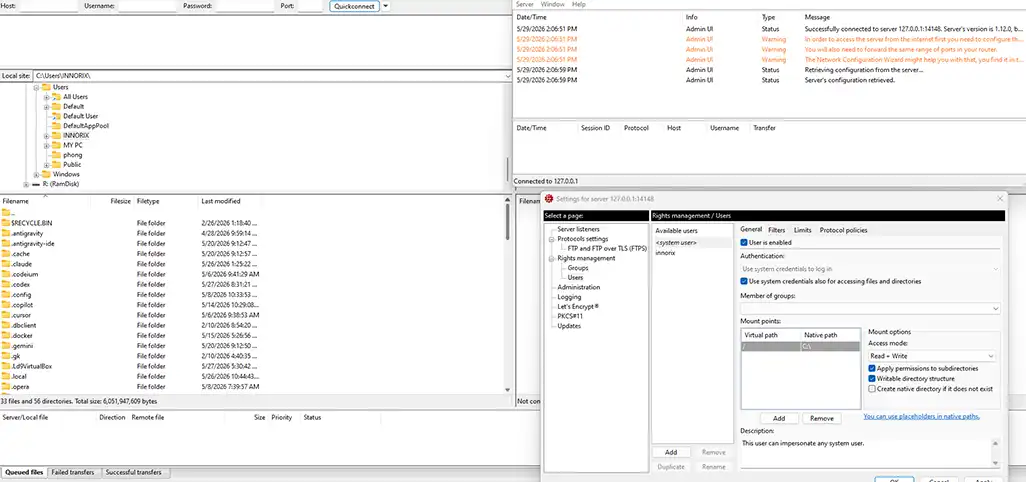 [OS Screen] FTP client login screen, browser upload queue, and multi-step copy processes via intermediate storage such as NAS
| Item (Aspect) | Core Problem | Technical Cause | Applicable Environment | Impact / Characteristics |
|---|---|---|---|---|
| Intermediate Server Dependency | Data must pass through intermediaries | No direct transfer protocol | Enterprise file transfer environments | Increased latency and complexity |
| Shared Storage Bottleneck | Centralized processing via storage | NAS/file server architecture | Corporate file sharing systems | Performance degradation due to congestion |
| Legacy Protocol Dependency | Use of FTP, SMB | Maintained for compatibility/security | Enterprise data exchange | Security vulnerabilities and overhead |
| Physical Media Dependency | Use of USB or offline transfer | No network alternative | Restricted/offline environments | Delay and risk of loss |
| Detour Cost Increase | Unnecessary infrastructure cost | Lack of direct connection | Hybrid cloud/on-prem environments | Operational inefficiency |
Unified Protocol Breaking OS Boundaries: Seamless Transfer Across Windows, macOS, and Linux Distributions#
A unique compatibility technology enabling seamless communication across diverse systems including CentOS, Debian, Red Hat, Fedora, and Mint.
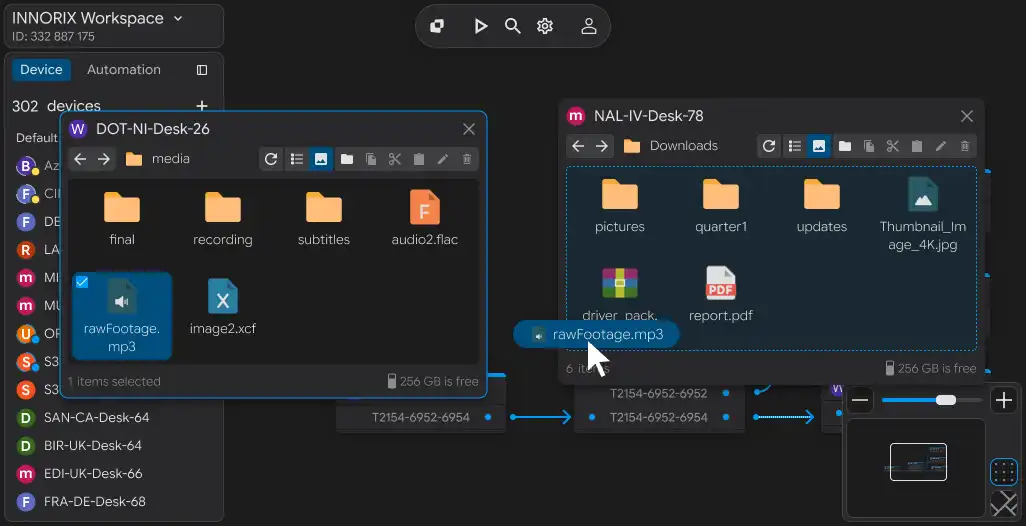 [Transfer UI] INNORIX console selecting Windows as source and Linux distribution as target, instantly activating transfer without complex setup
| Item (Aspect) | Core Technology Concept | Operating Principle | Applicable Environment | Key Effect |
|---|---|---|---|---|
| Session Persistence Transfer | Maintains same session despite network change | Tracks IP changes while preserving session ID | Mobile/multi-network environments | Continuous connection |
| Real-Time Network Awareness | Detects network changes instantly | Dynamic routing and path updates | Wi-Fi ↔ LTE ↔ 5G environments | Uninterrupted flow |
| Abstracted Transfer Layer | Logical connection independent of physical network | Virtualized transfer layer | Heterogeneous network environments | Minimal transition impact |
| Automatic Recovery Mechanism | Immediate restoration after disconnection | State monitoring and auto reconnect | Unstable mobile environments | No manual intervention |
| Intelligent Flow Control | Optimizes transfer based on environment | Dynamic adjustment based on network quality | Mixed high/low speed networks | Stability and efficiency |
Cloud Direct Bridge: Direct Connection Across S3, Azure Blob, and Other Object Storage Without Intermediaries#
Direct cloud-to-cloud transfers without API development, achievable with a single click.
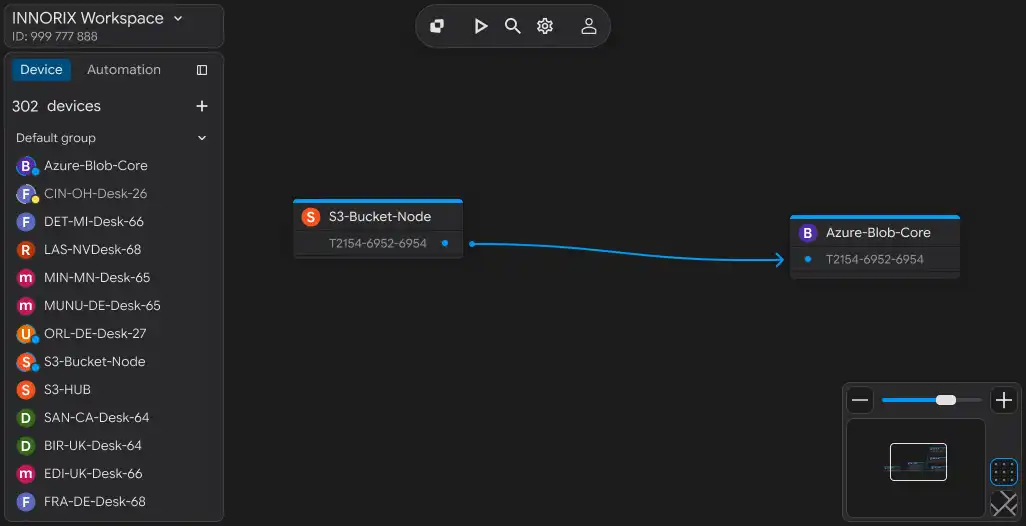 [Monitor UI] Real-time transfer between AWS S3 bucket and Azure Blob storage without intermediate routing
| Item (Aspect) | Core Technology Concept | Operation Method | Applicable Scenario | Key Effect |
|---|---|---|---|---|
| Ultra-fast Failure Detection | Detects disconnection instantly | <0.1s monitoring | Mobile environments | Minimized downtime |
| Automatic Path Reconstruction | Rebuilds broken path instantly | Real-time routing updates | Network switching | No recovery delay |
| Seamless Recovery | Restores without user awareness | Background session maintenance | Unstable networks | Continuous transfer |
| Predictive Restoration | Restores based on previous state | Network pattern analysis | High mobility | Minimized impact |
| Zero-time Transition | Approaches zero transition delay | Handover masking | Frequent switching | Seamless UX |
Completion of Hybrid Infrastructure: Ultra-connectivity Unifying Cloud Storage and Local Servers#
A unified data flow that directly connects cloud and local environments without boundaries.
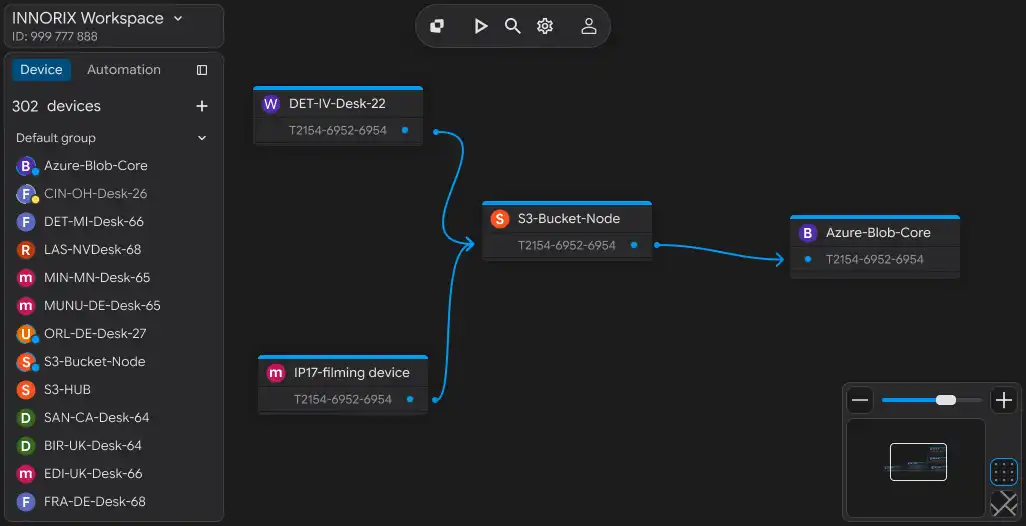 [Monitor UI] Unified queue connecting cloud storage paths and local disk paths with bidirectional transfer
| Item (Aspect) | Core Technology Concept | Operating Principle | Applicable Environment | Key Effect |
|---|---|---|---|---|
| Adaptive Bandwidth Control | Transfer adjusted to network speed | Real-time bandwidth-based tuning | Mixed 3G~5G environments | Stable transfer quality |
| Dynamic Packet Size Adjustment | Transfer unit adapts to environment | Packet restructuring based on network state | Low/high-speed transitions | Minimized loss and improved efficiency |
| Automatic Speed Optimization | Speed adapts to performance | QoS-based profiling | Mobile network variability | Continuous flow |
| Mixed Network Handling | Supports multiple bandwidth environments | Multi-link distributed transfer | Wi-Fi + LTE + 5G combined usage | Environment-independent transfer |
| Intelligent Performance Tuning | Continuously optimizes performance | AI-based network analysis | Highly variable environments | Maximum performance automatically maintained |
A Unified Global Transfer Network: Connecting Headquarters and Remote Branches with Real-Time Automation#
A centralized transfer system managing all endpoints globally as a single organism.
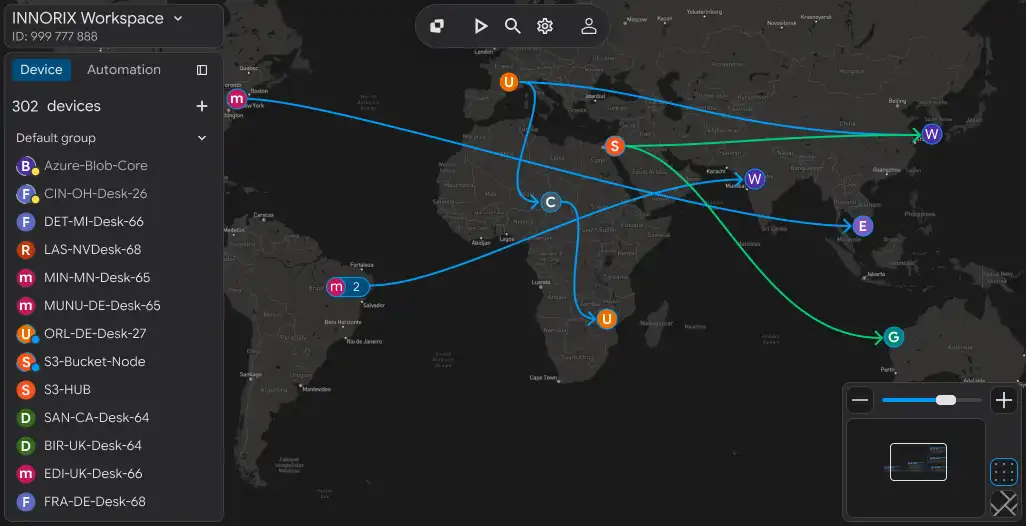 [Map/Topology] Global topology showing headquarters and branch systems connected with real-time data flow
| Item (Aspect) | Core Technology Concept | Verification Method | Applicable Environment | Key Effect |
|---|---|---|---|---|
| Bit-level Integrity Verification | Lossless accurate transfer | Bit comparison between source and destination | Mobile environments | Data accuracy guaranteed |
| Multi-switch Durability | Stability across repeated switching | Multiple handover scenario testing | Wi-Fi ↔ LTE ↔ 5G environments | Stability ensured |
| Automatic Error Detection | Detects corruption instantly | Checksum/hash validation | Unstable networks | Prevents data loss |
| Retransmission-based Recovery | Restores missing data automatically | Selective retransmission | High-variability networks | Complete recovery |
| End-to-End Consistency | Maintains identical data across transfer | Full validation pipeline | Enterprise transfers | 100% data consistency ensured |
Business Innovation Through Connectivity Freedom: True Universal Transfer Without Infrastructure Constraints#
A new paradigm proving that data can flow freely without technical limitations.
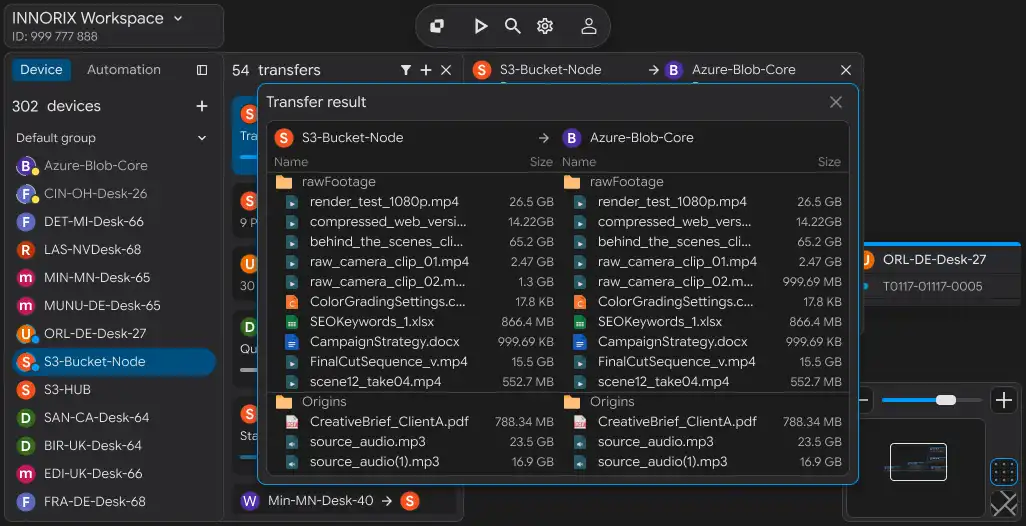 [Result UI] Final report showing all cross-OS and cross-cloud transfers completed successfully
| Item (Aspect) | Core Concept | Operation Method | Applicable Environment | Key Effect |
|---|---|---|---|---|
| Location-independent Transfer | Data flow independent of physical location | Network-based abstraction | Global/remote environments | No location constraint |
| Infrastructure Boundary Removal | Unified transfer without dedicated lines | Direct cloud/on-prem connection | Hybrid IT environments | Reduced cost and constraints |
| Continuous Workflow | No interruption during transfer | Session persistence and state-based transfer | Mobile/field operations | Maximum productivity |
| Global Unified Network | Integrated global endpoints | Centralized control | Multi-region enterprise | Reduced complexity |
| Infinite Scalability | Same performance regardless of scale | Distributed architecture | Large-scale data environments | Scalability and flexibility ensured |