
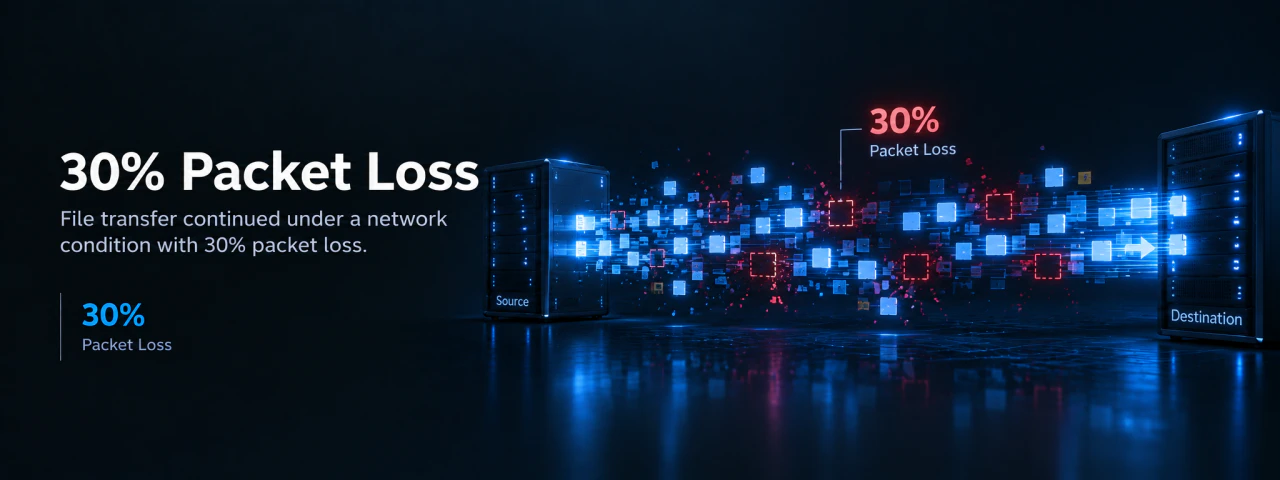
An Uncontrollable Communication Wasteland: A Desperate Network Emulation Where 30 Out of 100 Packets Disappear#
A harsh data environment with 30% packet loss, where conventional transfer protocols effectively cease to function.
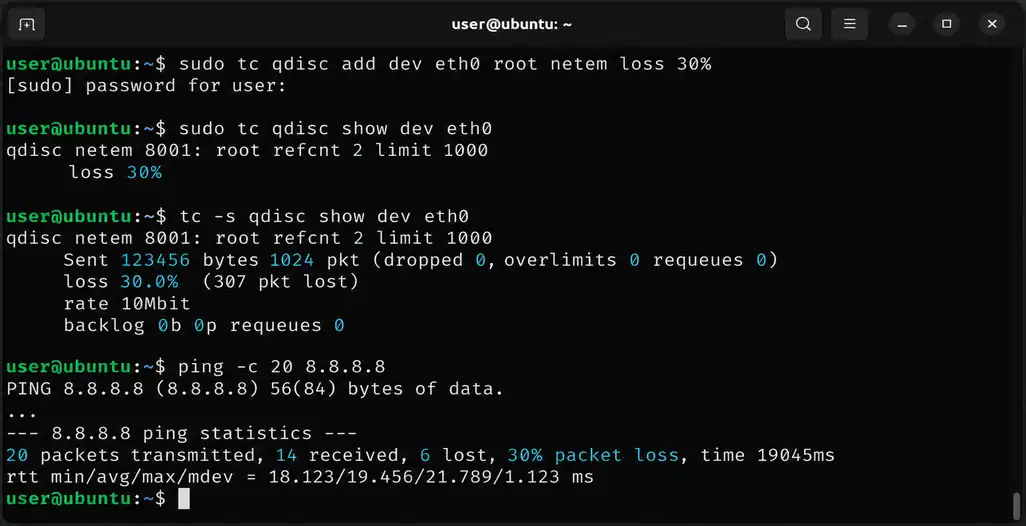 A terminal screen where packet loss is forcibly set to 30% using a network emulator or Linux command (tc qdisc)
| Item | Config Value | Meaning | Network Impact |
|---|---|---|---|
| Packet Loss Rate | 30% | 3 out of 10 lost | Communication becomes impractical |
| Loss Pattern | Random / Burst mixed | Continuous + intermittent loss | Maximized recovery difficulty |
| RTT (Latency) | 100 ~ 500ms | Long-distance / satellite assumption | Increased retransmission delay |
| Jitter | 50 ~ 200ms | Response variability | Unstable transfer speed |
| Bandwidth Limit | 10Mbps ~ 100Mbps | Limited link environment | Performance Bottleneck |
| Packet Reordering | Partial occurrence | Out-of-order packets | Increased receiver processing load |
| Test Method | tc qdisc / network emulator | Forced environment control | Reproducible experiment |
| Expected Result | TCP performance collapse | Congestion control malfunction | Speed converges to 0 |
Collapse of Legacy TCP Transfer: Technical Limitation Where Even Minor Loss Causes Throughput to Plummet#
Accumulated latency from retransmission requests drives transfer efficiency toward zero.
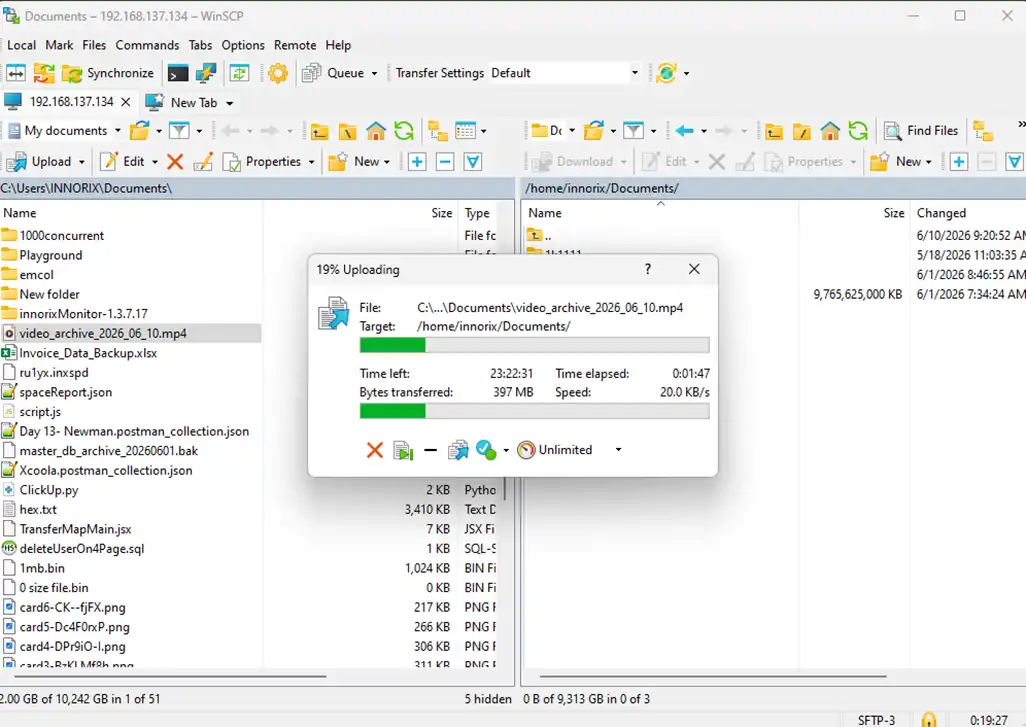 A transfer graph showing speed dropping to KB/s or near 0 with “Calculating remaining time” in a typical OS file copy
| Stage | Network State | TCP Behavior | Internal Mechanism Change | Result |
|---|---|---|---|---|
| 1. Normal Transfer | Initial data send | Window expansion (Slow Start) | Gradual throughput increase | Speed rises |
| 2. Packet Loss Occurs | Partial loss | Duplicate ACK received | Loss detection starts | Unstable transfer |
| 3. Retransmission Trigger | Missing ACK / Timeout | Retransmit packets | RTT increases | Delay accumulates |
| 4. Congestion Control | Repeated loss | Window size sharply reduced | Forced throughput decrease | Speed drops sharply |
| 5. RTT Increase | Waiting time grows | Timeout expands | Waiting accumulates | Transfer stalls |
| 6. Additional Loss | Continuous 30% loss | Repeated retransmission | Vicious cycle forms | Efficiency collapses |
| 7. Window Collapse | Shrinks to minimum | Throughput limited | Slow recovery | Near unusable |
| 8. Final State | Persistent loss | Repeated attempts only | Minimal actual delivery | Speed → 0 |
Intelligent Packet Tracking Engine: Precisely Identifying Missing Data in Real Time and Reconstructing It#
A proprietary INNORIX algorithm that selectively recovers only missing data without exhausting full bandwidth.
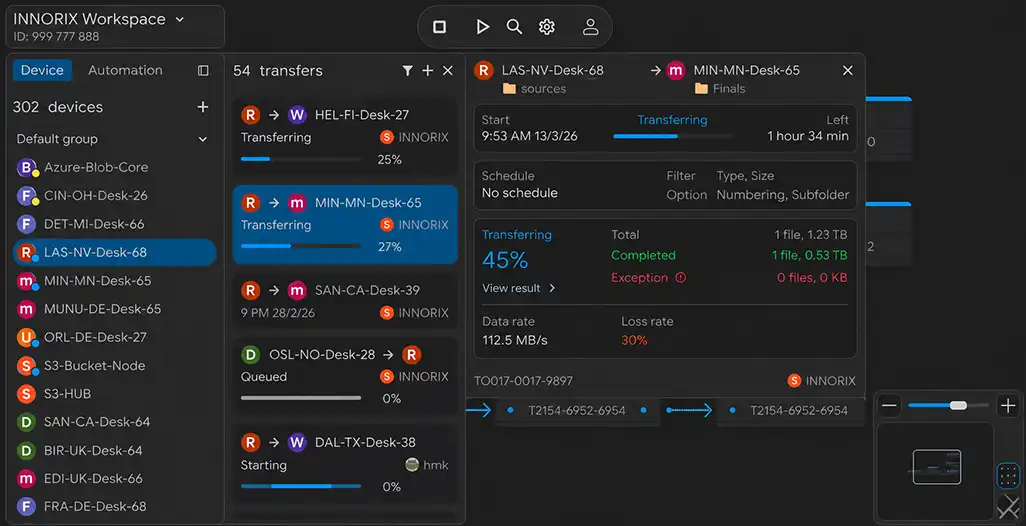 INNORIX UI showing transfer instantly progressing despite 30% loss, with data blocks filling rapidly
| Stage | Network Condition | INNORIX Engine Behavior | Processing Method | Result |
|---|---|---|---|---|
| 1. Data Transfer | 30% packet loss | Maintains full streaming | No interruption | Continuous transfer |
| 2. Loss Detection | Missing blocks | Real-time tracking | Block-level identification | Precise detection |
| 3. State Recording | Received vs missing | Transfer map generated | Bit/block management | Full visibility |
| 4. Recovery Target Selection | Missing data exists | Select only lost blocks | Selective request | Eliminates redundancy |
| 5. Retransmission | Only required parts | Parallel recovery | Distributed usage | Fast reconstruction |
| 6. Flow Maintenance | Concurrent transfer | Continuous streaming | No interruption | Stable speed |
| 7. Repeated Loss Handling | Ongoing loss | Same logic reapplied | Auto correction | Stable transfer |
| 8. Final Convergence | All blocks received | Missing = 0 | Fully reconstructed | 100% recovery |
Breakthrough in High-Latency Environments: Sustained High-Speed Transfer Even Over Satellite or Global Networks#
Bandwidth optimization technology that maintains constant speed regardless of RTT.
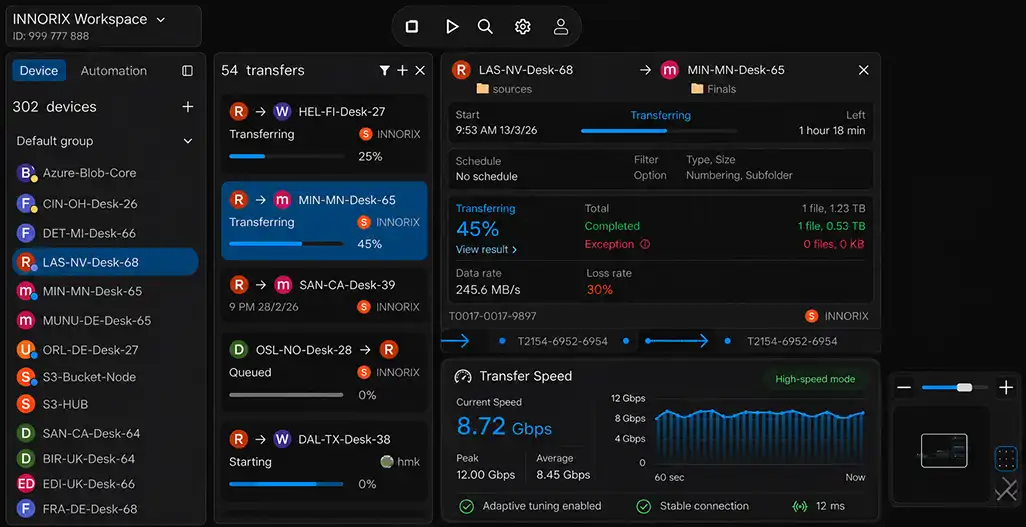 INNORIX monitor showing stable high throughput despite RTT exceeding 500ms
| Item | Legacy TCP Transfer | Problem | INNORIX Method | Result |
|---|---|---|---|---|
| RTT Dependency | Directly proportional | Speed drops with distance | RTT-independent | Constant speed |
| Round-trip Structure | ACK-based required | Waiting accumulates | Asynchronous streaming | No wait |
| Transfer Window | Limited by RTT | Throughput constrained | Parallel streams | Throughput maintained |
| Loss + Delay | Retransmission delay grows | Performance collapse | Independent handling | Minimal impact |
| Bandwidth Usage | Drops with RTT | Inefficiency | Continuous utilization | Maximized |
| Speed Variability | Highly volatile | Unstable transfer | Stable rate | Stability ensured |
| Long-distance | Degrades over WAN/satellite | Not practical | Same performance | Global ready |
| Final Result | “Farther = slower” | Structural limitation | “Distance irrelevant” | Consistent transfer |
Seamless Data Streaming: Autonomous Transfer That Adapts to Network Variability Without Intervention#
A flexible engine that dynamically adjusts throughput in real time based on changing network conditions.
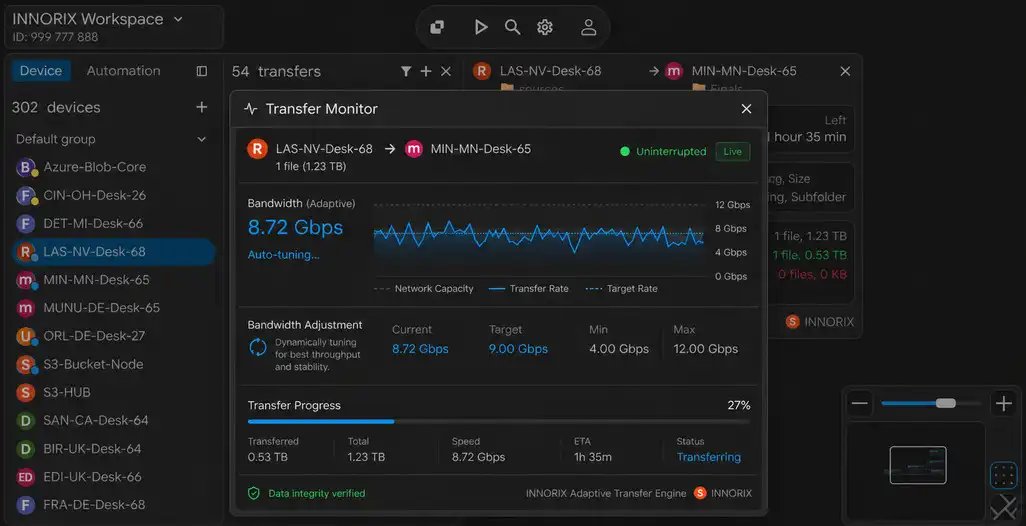 Monitor showing fluctuating network graph while INNORIX dynamically tunes bandwidth and maintains uninterrupted transfer
| Situation | Network Change | Legacy Response | Problem | INNORIX Behavior | Result |
|---|---|---|---|---|---|
| Bandwidth Drop | Sudden congestion | Speed collapse | Unstable session | Auto rate reduction | Connection maintained |
| Bandwidth Recovery | Congestion cleared | Slow recovery | Delay persists | Immediate expansion | Performance restored |
| Increased Loss | Higher loss rate | Retransmission spike | Speed collapse | Selective recovery | Flow maintained |
| RTT Increase | Latency rise | ACK delay | Transfer stalls | Async streaming | Minimal impact |
| Jitter | Irregular delay | Speed fluctuation | Instability | Buffering + tuning | Stability maintained |
| Short Disconnection | Temporary drop | Transfer failure | Restart needed | Auto reconnect + resume | Stability maintained |
| Repeated Variability | Constant change | Continuous instability | Requires management | Real-time tuning | Unmanned operation |
| Final State | Unpredictable | Unstable / failure | Operational risk | Seamless streaming | Stable completion |
A Revolutionary Alternative to Infrastructure Investment: High-Quality Transfer Over Public Networks Without Expensive Lines#
Overcoming poor network conditions through software without requiring costly infrastructure.
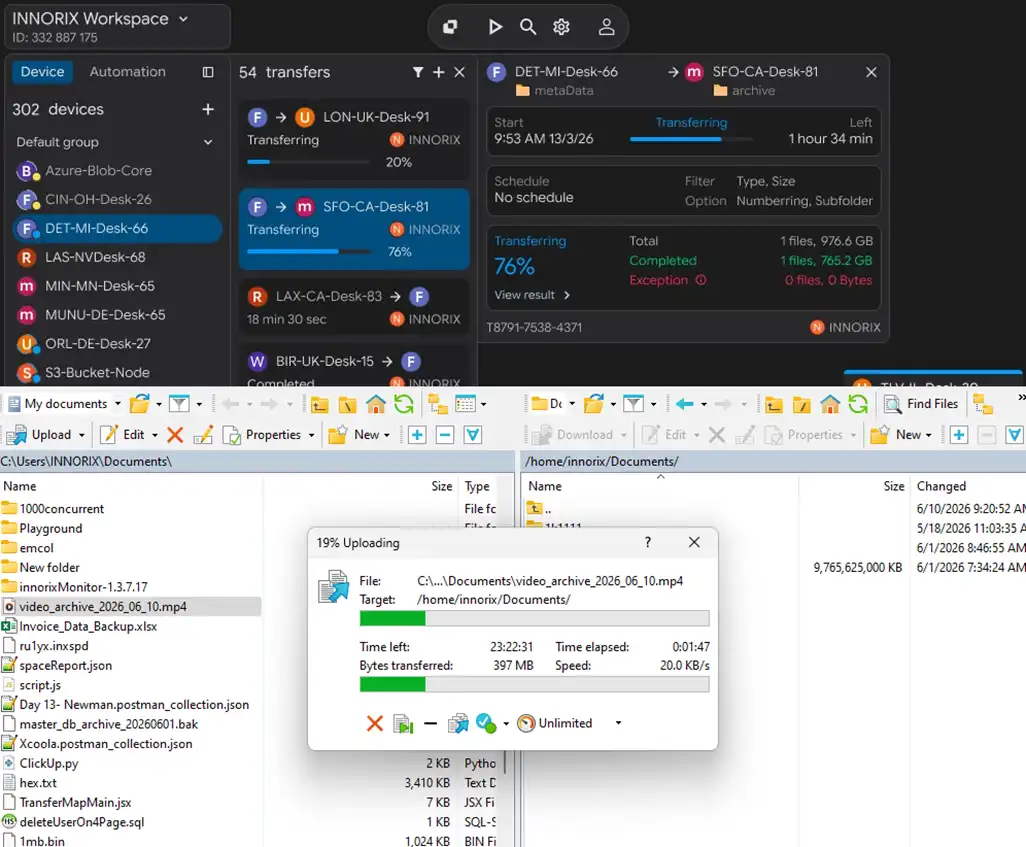 Comparison of low-cost public network ping test vs high-speed INNORIX transfer report
| Item | Legacy Method (Infrastructure Dependent) | Limitation | INNORIX Method (Software-Driven) | Result |
|---|---|---|---|---|
| Network Requirement | Low loss / low latency required | Environment constrained | Handles high loss/latency | Works anywhere |
| Circuit | MPLS / dedicated lines | High cost | Public internet | Cost reduction |
| Performance | Depends on infrastructure | Limited efficiency | Engine compensates | Stable performance |
| Loss Handling | Depends on network quality | Not fundamentally solved | Selective recovery | Guaranteed quality |
| Latency Handling | Affected by distance | WAN degradation | RTT-independent | Global consistency |
| Scalability | Requires line expansion | Cost/time increase | Software scaling | Instant expansion |
| Operational Cost | Continuous circuit cost | OPEX increase | Minimal infra | Cost optimized |
| Deployment | Complex network design | Requires experts | Plug-and-play | Fast adoption |
| Final Result | “Only works on good networks” | Limited | “Works on any network” | Infrastructure independent |
Unchanging Transfer Integrity: Zero-Byte Error Result Despite Millions of Packet Loss Events#
Final proof that even under extreme loss, the delivered data matches the original at the bit level.
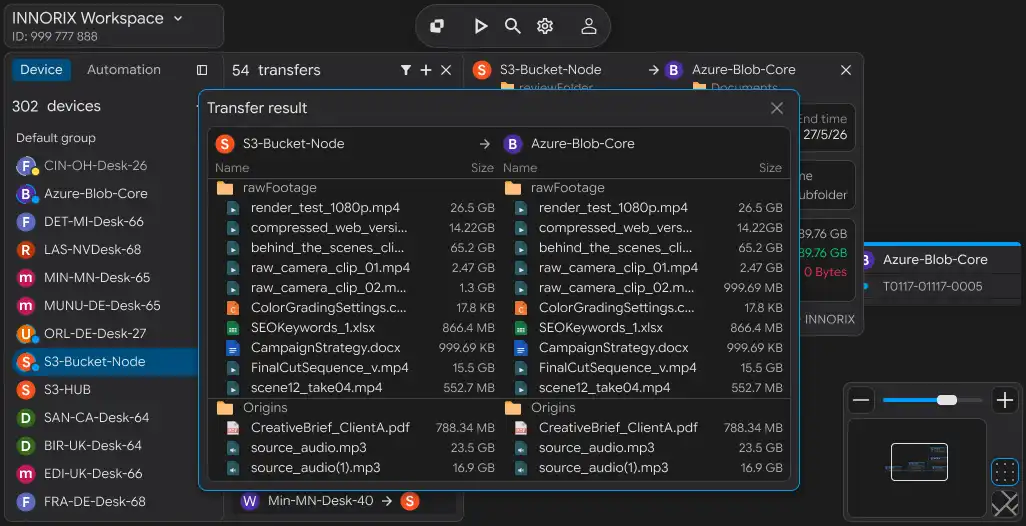 Final report showing millions of packet recovery logs and ‘Integrity Check: 100% Match’
| Verification Item | Legacy Result | Limitation | INNORIX Method | Final Result |
|---|---|---|---|---|
| Packet Loss Impact | Possible data loss | Incomplete recovery | Full block recovery | 100% received |
| File Count | Some failures | Hard to detect | Full comparison | Exact match |
| Total Data Volume | Approximate | Cannot detect corruption | Byte-level comparison | Identical |
| Data Content | Possible corruption | Hidden errors | Bit-level verification | Zero-byte error |
| Checksum | Partial validation | Low reliability | Full hash comparison | Perfect match |
| In-transfer Validation | Limited | Error accumulation | Real-time validation | Immediate correction |
| Failure Accumulation | Quality degradation | Reliability collapse | Independent of failures | Same result |
| Final Verdict | “Transfer complete” (uncertain) | Uncertainty | “Identical to original” | 100% integrity confirmed |